
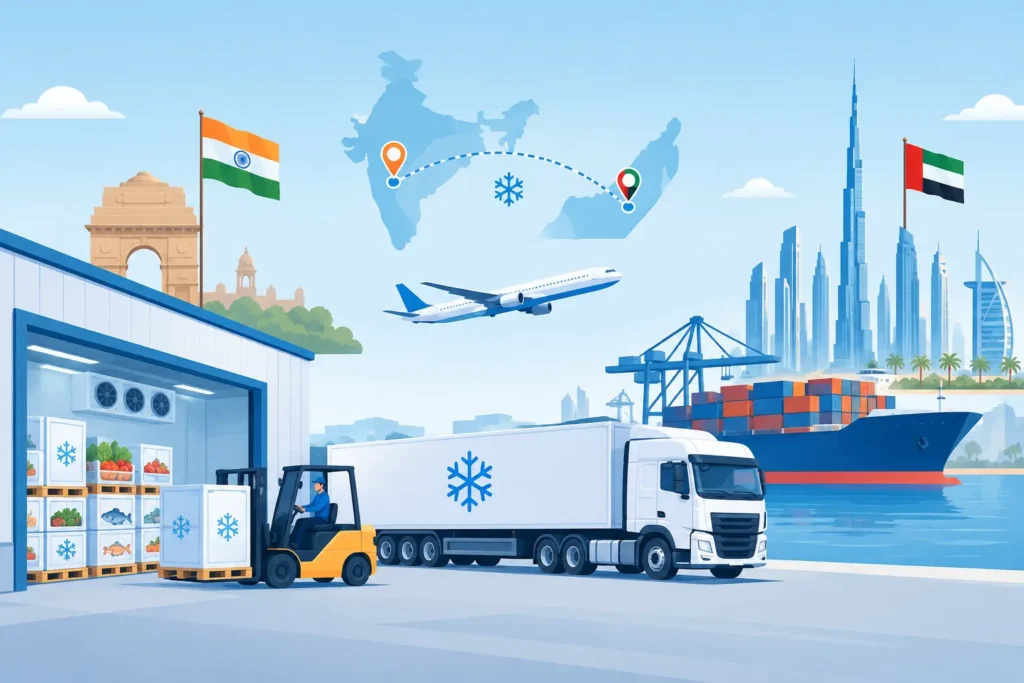
A shipment can clear customs on time, arrive at the correct destination, and still be a commercial failure if its temperature history is not right. For pharmaceutical products, fresh produce, frozen foods, specialty chemicals, and other sensitive cargo, this cold chain freight guide focuses on the details that protect product quality from pickup through final delivery.
Temperature-controlled freight is not simply standard cargo placed inside a refrigerated truck or container. It is a coordinated process involving product specifications, qualified equipment, transit planning, documentation, customs timing, monitoring, and delivery handover. That coordination matters on India-UAE routes, where air and ocean connections can be fast but port, airport, and clearance delays can still expose cargo to risk.
What Cold Chain Freight Requires
A cold chain is the controlled movement of cargo within a defined temperature range. The acceptable range depends on the product, not on the freight mode. Some pharmaceutical products may require 35°F to 46°F, frozen food may need to remain at or below 0°F, and fresh produce may require a narrow range with controlled humidity and ventilation.
The first question is not, “Do I need refrigerated freight?” It is, “What conditions must this product maintain, for how long, and what evidence will the consignee require?” A shipment may need protection from freezing, protection from heat, ventilation, humidity control, or all of these at different stages.
Temperature excursions are not always caused by a refrigeration unit failing. Cargo can be compromised during loading, while waiting on a terminal ramp, during a customs inspection, or when a vehicle door remains open too long at delivery. A reliable plan accounts for these transfer points rather than looking only at the main flight or vessel transit.
Start With a Product Profile
Before requesting rates, prepare a product profile that gives the freight forwarder and carrier the information needed to select the right solution. This should identify the required temperature range, acceptable excursion limits, shelf life, packaging type, commodity classification, and any regulatory requirements.
For pharmaceuticals, include whether the cargo is active or passive temperature-controlled, whether it needs a validated lane, and whether data logger records must be shared at destination. For food products, confirm whether the shipment requires pre-cooling, ventilation, controlled atmosphere handling, or cold storage on arrival. For chemicals, review the safety data sheet and determine whether temperature control is linked to product stability, safety, or both.
Packaging deserves the same attention as the transport booking. Insulated shippers, gel packs, dry ice, thermal covers, pallet wraps, and active containers each serve different purposes. Passive packaging can be cost-effective for shorter, predictable movements, while active containers provide greater control for high-value or highly sensitive cargo. The correct choice depends on the route, handling exposure, shipment value, and risk tolerance.
Choosing Air, Ocean, or Road Freight
The best mode is usually the one that protects the product and meets the commercial deadline, not automatically the fastest or lowest-cost option.
Air freight is often preferred for urgent pharmaceuticals, perishable foods, and cargo with limited shelf life. It shortens overall transit time, but it also involves several handovers between pickup, airport acceptance, warehouse storage, flight loading, and destination clearance. Booking confirmed capacity, arranging temperature-controlled airport handling, and allowing enough time for export documentation are essential.
Ocean freight is generally more economical for larger volumes, especially frozen or chilled food, ingredients, and temperature-sensitive raw materials. Reefer containers can provide consistent control during the voyage, but ocean freight requires careful attention to pre-trip inspection, set point confirmation, ventilation settings, electrical plug-in availability, and port dwell time. A low ocean rate offers little value if cargo waits unpowered or clearance is delayed at destination.
Road freight is central to first-mile and final-mile protection. It is also a practical choice for regional Gulf distribution after arrival in the UAE. The vehicle must be suitable for the set point, pre-cooled before loading, and operated by a team that understands loading discipline. Product should not be loaded against blocked air vents or stacked in a way that prevents circulation.
A Cold Chain Freight Guide to Route Planning
A strong cold chain freight plan maps the shipment from factory door to consignee door. This includes the planned transit time, likely handovers, storage points, weekends and holidays, customs clearance steps, and contingency options if a connection is missed.
For India-to-UAE shipments, departure city and destination matter. Cargo moving from an inland production site may need refrigerated trucking to an airport or seaport. The transfer window should be realistic, particularly during high temperatures, monsoon conditions, peak export periods, or congestion around major logistics hubs. The same applies in reverse for UAE-to-India cargo, where destination clearance requirements can affect how long cargo remains at an airport or port.
Avoid building a plan around the carrier’s published transit time alone. Published transit may cover airport-to-airport or port-to-port movement, while the cargo journey includes collection, security screening, terminal handling, customs release, and delivery appointment scheduling. Each extra touchpoint adds potential exposure.
A practical contingency plan should define who makes decisions if the shipment is delayed, where cargo can be moved for cold storage, who receives temperature alerts, and whether replacement packaging or additional refrigerant is available. For high-value shipments, this level of planning should be agreed before cargo pickup, not after an exception occurs.
Documentation and Customs Cannot Be an Afterthought
Cold chain cargo still requires the same core trade documents as other international shipments, including commercial invoices, packing lists, transport documents, and certificates relevant to the commodity. However, the product category may create additional requirements.
Food shipments may require health certificates, certificates of origin, product labels, or import approvals. Pharmaceutical and healthcare shipments can require licenses, product registration support, batch details, and controlled-temperature records. Certain chemicals may require safety declarations or permits. Requirements vary by product, origin, destination, and intended use, so documentation should be checked well before the cargo is ready.
Customs readiness is a temperature-control measure. Incorrect tariff classification, inconsistent invoice details, missing permits, or unclear product descriptions can delay release. For cargo with a narrow temperature range, clearance planning should include document review before departure and coordination with the importer or consignee before arrival.
Monitoring Creates Accountability
Temperature monitoring provides evidence of what happened during transit. Data loggers can record temperature at set intervals, while GPS-enabled devices may also provide location, light exposure, shock, and door-opening alerts. The right device depends on the commodity and the level of traceability required.
A logger should be placed where it represents product conditions, not simply where it is convenient. It should also be activated correctly and protected from damage. For palletized cargo, placement may vary according to airflow patterns and shipper instructions. One device may not be enough for a large shipment with different exposure zones.
Monitoring is useful only when someone is responsible for acting on alerts. Establish escalation contacts for the shipper, consignee, freight forwarder, carrier, and warehouse. Define what counts as an acceptable excursion and what steps are required if one occurs. This can include moving cargo to a cold room, verifying equipment settings, arranging priority delivery, or quarantining product for quality review.
Control Costs Without Reducing Protection
Cold chain freight costs more than standard freight because it involves specialized equipment, handling, storage, packaging, and monitoring. Cost control should focus on planning accuracy rather than cutting the controls that protect product value.
Consolidating compatible shipments can reduce cost, but only when all products share suitable temperature and handling requirements. Choosing ocean reefer freight for stable, high-volume cargo can be more economical than air freight. At the same time, a less expensive route may be a poor choice if it introduces extra transfers, uncertain connections, or longer port dwell time.
Forecasting is one of the most effective cost measures. Regular shipment volumes allow earlier bookings, better equipment availability, and more consistent pickup scheduling. They also make it easier to establish approved operating procedures for recurring India-UAE and global trade lanes.
Mass Freight Forwarding can coordinate air, ocean, land transport, customs clearance, warehousing, and door-to-door handling around the cargo profile rather than forcing sensitive freight into a standard shipping process.
The right cold chain plan protects more than a pallet or container. It protects product integrity, customer commitments, regulatory compliance, and the reputation attached to every shipment. When conditions are defined early and every handover has an owner, temperature-sensitive cargo can move with the control serious trade demands.