
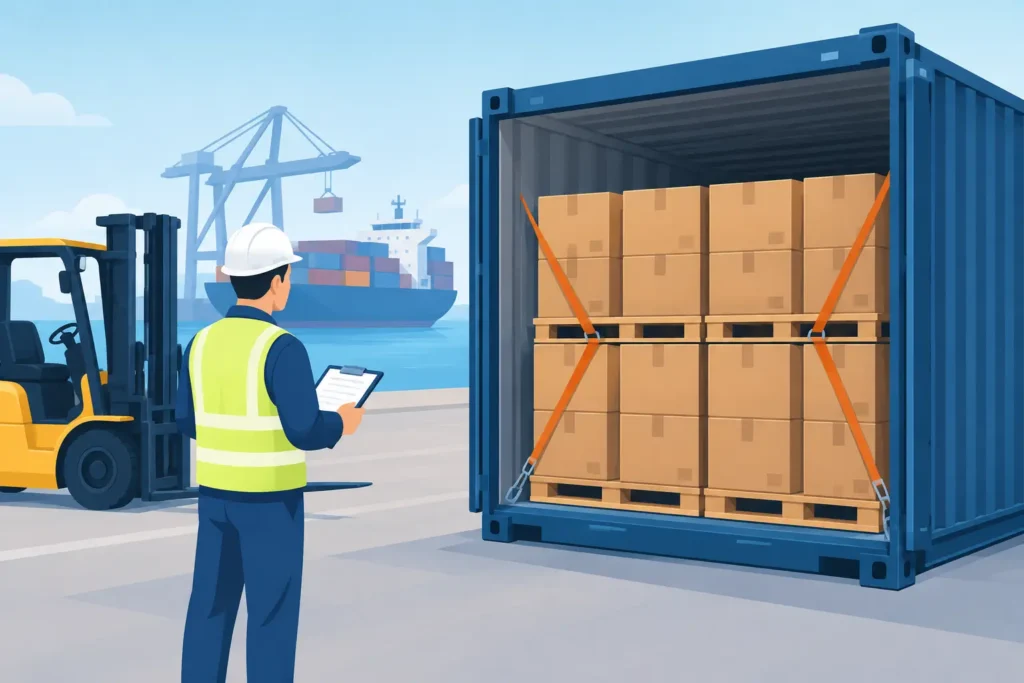
A container can leave the warehouse looking fully loaded and still arrive with damaged, shifted, or rejected cargo. The difference is rarely the container itself. It is usually the planning, packing, weight distribution, and securing decisions made before the doors are closed. Strong container loading practices protect product quality, support customs compliance, and help importers and exporters avoid costly claims across India, the UAE, and global trade lanes.
For supply chain managers, loading is not just a warehouse task. It is a control point where freight cost, delivery reliability, cargo safety, and customer commitments meet. A poorly loaded container can cause damaged goods, delays at inspection, unloading problems, and disputes over liability. A well-planned load gives the shipment a far better chance of arriving in the same condition in which it was dispatched.
Start With a Load Plan, Not an Empty Container
Loading should begin with accurate shipment information. Confirm the dimensions, gross weight, package count, stackability, handling marks, and sensitivity of every item. This information determines whether a 20-foot, 40-foot, 40-foot high-cube, open-top, flat rack, or another equipment type is appropriate.
The lowest ocean freight rate is not always the lowest total cost. A container that is too small may force unsafe loading or leave no room for proper bracing. A container that is too large may create excess void space, increasing the risk of movement during transit. For heavy machinery, vehicles, steel products, fragile goods, or project cargo, equipment selection should be based on securing requirements as much as volume.
A practical load plan identifies the loading sequence before cargo reaches the stuffing area. It should show where heavy units will sit, which cartons may be stacked, where dunnage is needed, and how the final rows will be restrained. This is particularly valuable for mixed loads, LCL consolidation, and cargo moving through multiple warehouses before export.
Check the Container Before Loading
A sound load plan cannot compensate for an unsuitable container. Inspect the unit at the point of stuffing. The floor should be dry, clean, and free from protruding nails, holes, oil residue, or signs of structural weakness. Check the sidewalls, roof, doors, locking bars, seals, and ventilation openings.
Odor and moisture matter, especially for food products, textiles, paper, electronics, furniture, and packaged consumer goods. If the container has water marks, condensation, pests, or damage that could affect cargo, request a replacement before loading begins. Record the container number and take clear photographs of its condition. These records are useful if a claim arises later.
Container Loading Practices for Weight Distribution
Weight distribution is one of the most important parts of safe container loading practices. Place the heaviest cargo low and close to the container’s centerline. Distribute weight evenly from left to right and along the length of the container, avoiding concentrated loads that can damage the floor or make the unit unstable during handling.
Do not assume that a container can carry any load below its maximum payload. Cargo may have a high point load even when the total weight is within limits. Machinery with narrow feet, dense metal components, or palletized goods with small contact points may require timber bearers, load-spreading materials, or specially designed cradles.
Weight also affects transport beyond the port. Road axle limits, terminal rules, and local regulations in India, the UAE, and destination countries may restrict how the container is moved after stuffing. Share verified cargo weights early with the freight forwarder and transporter. Last-minute changes to the packing list can create problems with vehicle allocation, VGM submissions, and port acceptance.
Secure Cargo for the Full Journey
Containers experience more than forward movement. Cargo can shift during truck braking, vessel rolling, lifting, rail movement, port handling, and rough road conditions. Friction alone is not a securing method. Even tightly packed cartons can move when they are exposed to repeated vibration or a sudden impact.
The right securing method depends on the cargo. Palletized goods may require stretch wrap, anti-slip mats, blocking, bracing, and lashing straps. Heavy equipment may need chains, wire rope, turnbuckles, timber blocking, and purpose-built lashing points. Vehicles require wheel chocks and rated lashings. Fragile cargo needs suitable internal packaging as well as restraint against movement.
Void spaces deserve special attention. Gaps between cargo and container walls should be filled or restrained with materials suited to the weight and movement risk of the shipment. Dunnage bags can be effective for stable pallet loads, but they are not a substitute for proper blocking when cargo is heavy or capable of rolling. Cardboard, loose timber, or improvised materials often fail under pressure.
Use rated securing equipment and inspect it before use. Damaged straps, weak anchor points, or incorrectly tensioned lashings can create a false sense of security. For oversized, high-value, or unusually shaped cargo, a cargo lashing plan prepared by experienced specialists is a worthwhile safeguard.
Prevent Moisture and Condensation Damage
Cargo damage is not always caused by impact. Temperature changes during an ocean voyage can cause condensation inside a container, sometimes called container rain. This can affect cartons, labels, textiles, metal products, and moisture-sensitive components.
The solution depends on the commodity and route. Cargo should be dry before loading, with packaging designed for the expected transit conditions. Desiccants, moisture barriers, liners, and proper pallet placement may be appropriate. Avoid loading wet pallets, freshly washed goods, or cargo that has been exposed to rain without allowing adequate drying time.
For shipments moving between hot, humid regions and cooler destinations, moisture control should be discussed during booking rather than after cargo has been packed. The right preventive measure is usually less expensive than replacing damaged stock at destination.
Document the Load and Seal It Correctly
Photographs and loading records are practical risk-management tools. Capture the empty container inspection, the cargo condition before loading, each major stage of stuffing, the securing arrangement, the final door-end view, and the seal applied to the container. Make sure images clearly show the container number when possible.
The packing list, commercial invoice, shipping instructions, and verified gross mass must match the cargo actually loaded. Inaccurate descriptions or quantities can lead to customs queries, clearance delays, penalties, or insurance complications. This is especially relevant when shipments include multiple product types, spare parts, machinery, or goods requiring specific permits.
Apply a high-security seal after the doors are closed, and record the seal number on the relevant shipping documents. The consignee should verify the seal before opening the container at destination. If the seal is broken, missing, or does not match the documentation, the issue should be reported and documented before unloading.
Match Loading Methods to the Cargo and Route
There is no single loading method that suits every shipment. A full container of uniform, palletized consumer goods requires a different approach from a container carrying marble, automotive parts, industrial equipment, or retail stock for multiple destinations. The route matters too. A short regional movement may have fewer handling points than a shipment crossing several ports and inland transport networks, but both still require secure loading.
Importers and exporters should also consider who will unload the cargo. Floor-loaded cartons can maximize cube utilization, yet they may take longer to discharge and create manual handling risks. Palletization may reduce the total quantity loaded but can improve warehouse receiving speed and inventory control. The right choice depends on product value, labor availability, delivery schedule, and the consignee’s receiving facilities.
For India-UAE trade, customs documentation, port cutoffs, truck availability, and delivery appointments should be coordinated alongside the physical loading plan. A correctly packed container that misses a vessel cutoff still affects the supply chain. Loading teams, customs specialists, carriers, and freight forwarders need the same shipment information early enough to act on it.
When Expert Supervision Adds Value
Routine cargo may be loaded safely by a trained warehouse team following clear instructions. However, supervision becomes more valuable when the shipment involves high-value goods, heavy machinery, luxury vehicles, out-of-gauge cargo, hazardous materials, or complex mixed loads. These shipments carry greater exposure if cargo shifts, packaging fails, or documentation does not reflect the actual load.
An experienced freight partner can coordinate equipment selection, cargo lashing, marine insurance, customs requirements, trucking, and destination delivery as one operational plan. At Mass Freight Forwarding, this practical coordination helps customers move cargo with greater control across India, the UAE, and international markets.
Before the container doors close, ask a simple question: if this cargo is lifted, braked, rolled, inspected, and unloaded weeks from now, will every item still be protected and identifiable? Treating that question as part of the loading process helps turn a shipment from a potential claim into a dependable delivery.