
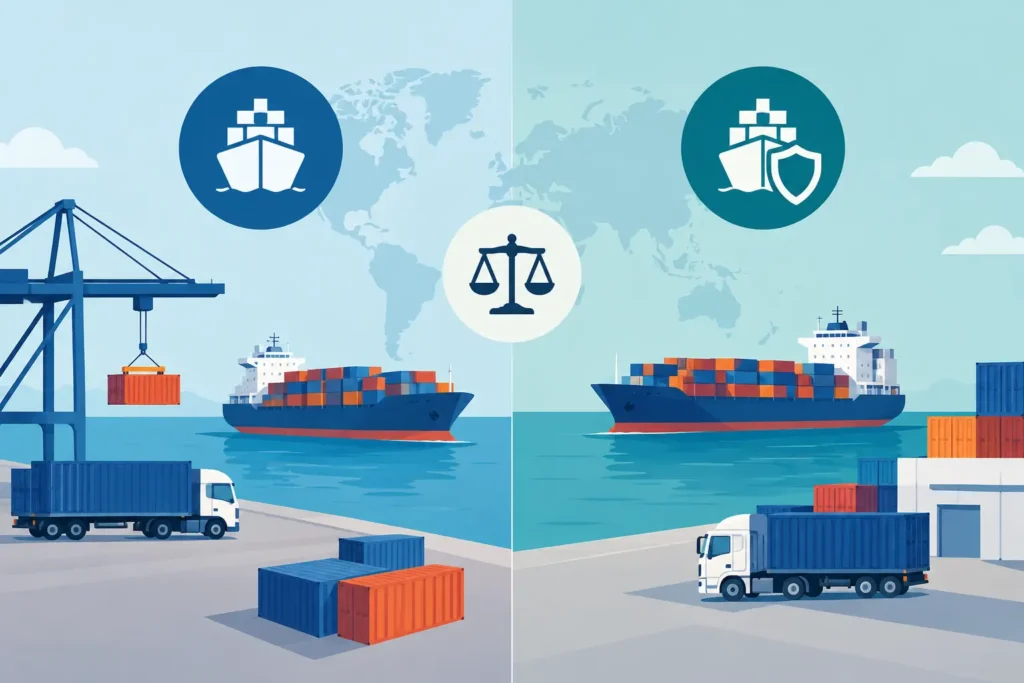
A container can be booked, loaded, and sailing on schedule while the buyer and seller still disagree about a basic question: who was responsible when the cargo was damaged? That is why FOB versus CIF is more than a freight-rate decision. These Incoterms define the handover point for risk, the allocation of transport costs, and the level of control each party has over the ocean shipment.
For businesses trading between India, the UAE, and international markets, the right term can protect margins and reduce avoidable disputes. The wrong one can leave an importer paying unexpected destination charges or an exporter managing transport they cannot fully control.
FOB versus CIF: The Key Difference
FOB means Free On Board. Under FOB, the seller is responsible for export clearance and for placing the goods on board the vessel nominated by the buyer at the agreed port of shipment. Once the cargo is on board, risk transfers from seller to buyer.
CIF means Cost, Insurance and Freight. The seller arranges and pays for ocean freight and marine insurance to the named destination port. However, this is the point many shippers miss: risk still transfers to the buyer when the goods are loaded on board the vessel at the origin port, not when they arrive at destination.
In practical terms, CIF gives the buyer a freight-inclusive price to the destination port, while FOB gives the buyer more authority to choose the carrier, routing, transit time, and freight forwarder. Neither term is automatically better. The correct choice depends on who has the purchasing power, freight expertise, cargo exposure, and ability to manage the destination side of the move.
What the Seller Handles Under FOB
With an FOB shipment, the seller prepares the goods, completes export documentation and customs formalities, delivers cargo to the port, and loads it on the vessel selected by the buyer. The seller’s obligations end at the point the cargo is on board.
The buyer takes responsibility for the main ocean freight, marine insurance, arrival notices, import clearance, duties, taxes, destination handling, and inland transport after arrival. Because the buyer selects the freight partner, FOB can provide better shipment visibility and tighter cost control.
FOB is often attractive to established importers that ship regularly from India or the UAE. A buyer moving multiple containers each month may receive stronger freight rates through its own forwarder than a supplier can obtain. It also allows the importer to consolidate cargo from several vendors into one shipment, which can reduce overall logistics costs.
There is a trade-off. The buyer must be ready to nominate the vessel, provide booking instructions on time, and coordinate with the supplier. If the booking is late or documents are incomplete, cargo can miss its planned sailing and incur storage or rollover charges.
What the Seller Handles Under CIF
Under CIF, the seller does more of the transport arranging. The seller books and pays the freight to the agreed destination port and purchases marine cargo insurance for the buyer’s benefit. The buyer still manages import customs clearance, local duties and taxes, port charges that are not included in the freight agreement, and delivery from the port to the final location.
CIF can be useful when a buyer is new to international trade or when the seller has better access to freight capacity from the origin market. A small importer purchasing one or two shipments may prefer receiving a price that includes the goods, insurance, and ocean freight to Jebel Ali, Nhava Sheva, or another named port.
But a CIF price should never be treated as a complete landed-cost figure. Destination terminal handling, documentation, customs brokerage, duty, VAT or other taxes, inspections, demurrage, detention, and inland delivery may remain payable by the buyer. Before approving a CIF purchase order, ask for a clear list of what is included, what is excluded, and which local charges may apply at destination.
Risk Transfers Earlier Than Many Buyers Expect
The biggest source of confusion in CIF transactions is insurance. Since the seller purchases insurance, buyers often assume the seller carries all risk until the vessel reaches the destination. That is not how CIF works.
Under both FOB and CIF, risk generally transfers when cargo is on board the vessel at the port of shipment. If a container is damaged during the ocean voyage, the buyer carries the commercial risk even under CIF. The insurance policy arranged by the seller is intended to provide protection for that risk, but the buyer needs to understand the policy terms before relying on it.
The minimum insurance required under CIF may not provide the broad protection needed for high-value machinery, electronics, automotive cargo, project equipment, or sensitive goods. Coverage can be limited, subject to exclusions, and based on the cargo value declared. Buyers should confirm the insured value, claims process, deductible, scope of coverage, and whether the policy covers the full journey through final delivery.
For higher-value cargo, separate or enhanced marine cargo insurance may be the more prudent option. A low freight price does not compensate for inadequate protection when a serious loss occurs.
Cost Control and Freight Visibility
FOB usually gives the buyer stronger control over the main freight component. The buyer can compare carrier schedules, negotiate freight rates, select transit routes, and appoint a forwarder that can coordinate customs clearance and delivery at destination. This is especially valuable for companies with recurring trade lanes between India and the UAE, where consistent volumes can support planned shipping programs.
CIF reduces the buyer’s involvement at origin, but it can limit transparency. The supplier may select a carrier based on its own commercial priorities, and the buyer may receive less flexibility on shipping dates or route selection. There can also be a gap between the CIF amount shown on the commercial invoice and the charges collected at destination.
That does not mean CIF is inherently more expensive or less reliable. A capable exporter may offer competitive freight and dependable sailing options. The decision should be based on a full comparison of landed cost, service quality, shipment urgency, and operational control rather than the headline ocean freight alone.
When FOB Is Usually the Better Fit
FOB often works well for importers that have an established logistics process and want one freight partner to manage shipments from multiple suppliers. It is particularly practical when the buyer needs to coordinate consolidation, specialized equipment, customs support, or delivery beyond the destination port.
Consider FOB when your business wants to choose the carrier, negotiate freight directly, consolidate supplier cargo, or maintain direct visibility over transport milestones. It can also be a better commercial structure when the buyer has experienced procurement and logistics teams that can manage bookings and document deadlines.
For example, a UAE distributor buying consumer goods from several Indian manufacturers may prefer FOB Nhava Sheva. Its appointed forwarder can collect cargo from different suppliers, combine compatible freight, ship under one coordinated plan, arrange UAE customs clearance, and deliver to the warehouse. That structure gives the distributor more control over cost and inventory timing.
When CIF Is Usually the Better Fit
CIF can be the practical choice when a buyer does not have regular ocean freight volume, has limited origin-market contacts, or prefers the supplier to arrange the initial shipping leg. It may also suit transactions where the seller can secure more reliable equipment availability from a difficult origin port.
Choose CIF carefully when simplicity at origin is more valuable than direct freight control. The purchase contract should identify the named destination port precisely, state the documents the seller must provide, and clarify responsibility for destination charges and customs clearance.
A first-time importer purchasing a single container of standard products may find CIF easier to administer, provided it has already arranged a trusted customs and delivery partner at destination. The buyer should still request the bill of lading details, insurance certificate, shipment schedule, cargo description, and advance notice needed for import planning.
A Container Shipping Caution: FOB May Not Always Be Ideal
FOB and CIF apply only to sea and inland waterway transport. For containerized cargo, goods are often delivered to a terminal before they are physically loaded onto a vessel. This can make the precise FOB risk-transfer point less practical, particularly when the buyer cannot control the vessel loading process.
In many container shipments, FCA, or Free Carrier, can be a cleaner alternative. Under FCA, risk transfers when the seller hands cargo to the carrier at the agreed place, such as a container freight station, factory, or port terminal. CPT and CIP may also be better suited to certain multimodal shipments.
The point is not to avoid FOB or CIF. Both remain widely used. It is to make sure the trade term matches the real cargo handover and the transport plan. A contract that uses the right Incoterm but names an unclear location can still create costly disagreements.
Questions to Settle Before Signing the Purchase Order
Before committing to FOB or CIF, confirm the exact named port or place, the party responsible for export and import clearance, and all charges included in the quoted price. Confirm who chooses the carrier, who provides the bill of lading instructions, and who pays for inspection, storage, demurrage, detention, and inland trucking if delays occur.
Also review the cargo insurance position in writing. If the shipment is CIF, do not assume the seller’s policy is sufficient for your cargo or commercial exposure. If it is FOB, arrange coverage before the risk transfer point.
For businesses moving goods through India, the UAE, and global trade lanes, a freight forwarder can help translate the sale contract into a workable shipping plan. Mass Freight Forwarding can coordinate ocean freight, customs handling, marine insurance, and final delivery so the commercial term is supported by clear execution on the ground.
Before your next shipment moves, match the Incoterm to your real capabilities, not just the price on the supplier’s quotation. Clear responsibilities at origin create fewer surprises at destination.