
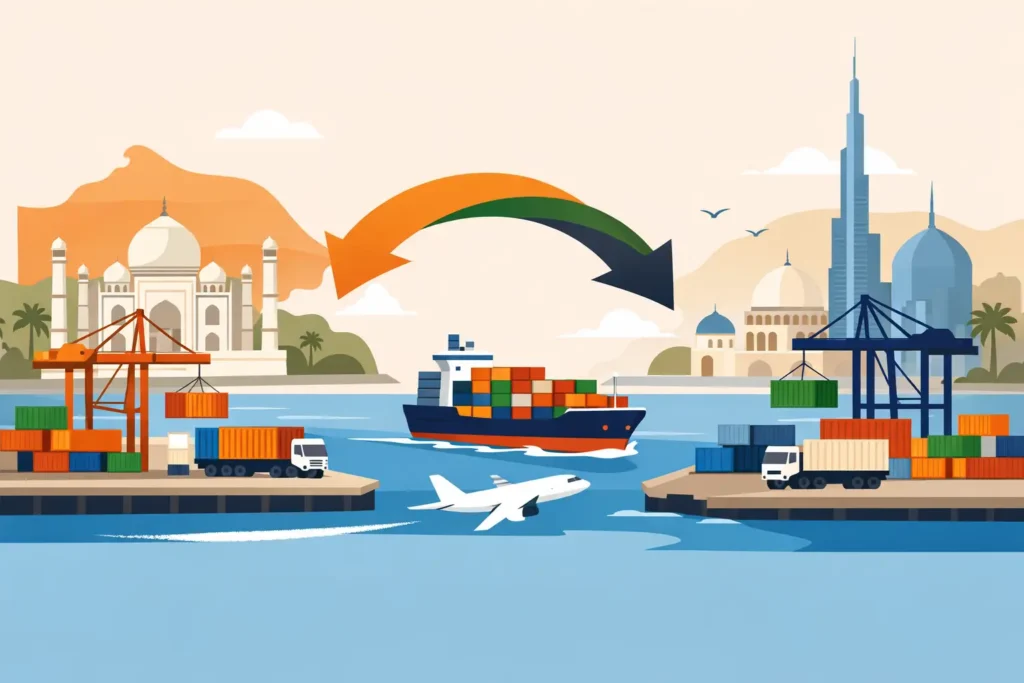
A production line in the UAE does not stop because a container is only one day late. It stops because the shipment was planned without enough time for documentation, port handling, customs clearance, and final delivery. This India UAE shipping case study examines how a coordinated freight plan helped a commercial importer move time-sensitive industrial cargo from India to the UAE while protecting its operating schedule.
The shipment is representative of a common India-UAE trade requirement: regular commercial cargo, a fixed delivery commitment, and little room for customs or port-related surprises. The company name and shipment details have been generalized, but the operational lessons apply to importers, exporters, procurement teams, and supply chain managers moving freight between both markets.
The Shipment Challenge
The importer, a UAE-based distributor of industrial components, needed to replenish inventory for customers in Dubai and the Northern Emirates. Its supplier in western India had completed a mixed shipment of machine parts, fittings, and packaged replacement components. The cargo was not oversized or hazardous, but it was commercially important: several customer orders depended on stock arriving before the end of the month.
The original plan was to ship by ocean freight as a less-than-container-load, or LCL, consignment. That choice made financial sense because the volume did not justify a full container. However, LCL shipments require more coordination than many shippers expect. Cargo must be collected on time, delivered to the consolidation warehouse before the cutoff, correctly packed and labeled, loaded with compatible freight, and supported by accurate documents at both ends.
The importer had faced recurring issues with previous shipments. Commercial invoices contained inconsistent part descriptions. Packing lists did not always match the actual carton count. Clearance instructions were sometimes provided after the cargo had already arrived. Each small gap created additional handling, questions from customs authorities, and avoidable storage exposure.
For this shipment, the objective was clear: move the cargo securely from the supplier in India to the consignee’s UAE facility, maintain visibility at key stages, and avoid delays that could affect customer commitments.
India UAE Shipping Case Study: The Freight Plan
The first decision was not the shipping line or the sailing date. It was confirming the cargo profile and documentation before collection. The logistics team reviewed the commercial invoice, packing list, consignee details, commodity descriptions, package dimensions, gross weight, and delivery location. This early review identified two descriptions that were too general for efficient customs processing. They were revised to state the components’ intended industrial use and material composition more clearly.
That adjustment was small, but it mattered. Customs documentation should describe goods accurately without being vague or misleading. Terms such as “machine items” or “spare material” may be technically true, yet they can invite questions when the shipment contains multiple products with different classifications or uses.
The cargo was then collected from the supplier and taken to the consolidation point in India. Before consolidation, the team checked carton condition, marks, dimensions, and package count against the packing list. One carton had weak outer strapping and was reinforced before export handling. This prevented a simple packaging issue from becoming a damage claim or a discrepancy at destination.
Ocean LCL was retained as the primary mode because the delivery window allowed for it and the importer prioritized cost control. An air freight alternative was discussed for a small group of critical replacement parts, but the client chose not to split the shipment. That was a reasonable decision in this instance. Splitting cargo can reduce risk for urgent items, but it also adds coordination, separate customs entries, and higher transport cost. The right choice depends on the value of the time saved versus the cost and complexity created.
Export Handling in India
Once the cargo entered the export process, the focus shifted to cutoff management and document consistency. The forwarding team coordinated cargo handover, consolidation, export customs procedures, and vessel booking. The importer received updates at meaningful milestones rather than a stream of status messages without context: cargo collected, cargo received for consolidation, export documentation completed, vessel departed, and arrival notice issued.
This level of visibility is especially useful for supply chain managers who must communicate with sales, warehouse, finance, and customer service teams. A shipment update should answer practical questions: Has the cargo departed? Are documents ready? Is there an action required from the importer? What is the expected next milestone?
UAE Arrival and Customs Clearance
Before the vessel arrived in the UAE, the consignee’s clearance documents and authority requirements were reviewed again. This pre-arrival work reduced the risk of discovering a missing instruction only after the cargo was available at the port.
At destination, the shipment moved through LCL deconsolidation, customs clearance, and delivery scheduling. Because the invoice and packing list had been checked before export, there was no need to rework the commercial documents after arrival. The clearance process proceeded without a document-driven hold, and delivery was arranged once the cargo became available.
The cargo was delivered to the consignee’s warehouse within the planned delivery window. More importantly, the receiving team had advance notice of the delivery schedule and could allocate labor and storage space. Freight forwarding does not end at port arrival. A shipment that clears quickly but arrives at an unprepared warehouse can still create operational disruption.
What Produced the Better Result
The successful outcome was not caused by one special shipping option. It came from controlling the handoffs that often create delay between India and the UAE.
First, documents were treated as operational tools, not paperwork to be completed at the end. The invoice, packing list, and cargo descriptions were aligned before the shipment entered the export flow. That gave both the exporter and importer time to correct issues without port storage pressure.
Second, the freight mode matched the cargo and commercial requirement. LCL ocean freight offered a cost-effective option for a shipment that did not need a dedicated container. Had the consignee required delivery within only a few days, air freight or a split-mode plan would likely have been more appropriate. Cost per shipment is only one measure. Inventory risk, customer commitments, product value, and lead-time tolerance all affect the right transport decision.
Third, origin and destination coordination reduced the usual gaps between export handling and UAE delivery. The shipment was not managed as separate tasks by unrelated parties. Collection, consolidation, export customs procedures, arrival planning, customs clearance, and final delivery were treated as one cargo movement.
Finally, the consignee was given clear action points. When an importer understands what documents are required, when payment or approval is needed, and what the expected delivery sequence looks like, the likelihood of a last-minute hold falls significantly.
Practical Lessons for India-UAE Shippers
For regular India-UAE trade, the most valuable improvements often happen before cargo reaches the port. Exporters should confirm that the invoice, packing list, package markings, and cargo measurements all match. Importers should share consignee instructions, clearance documents, and delivery requirements early enough to be reviewed before arrival.
It is also wise to plan for the actual nature of the cargo rather than selecting a mode based only on the lowest freight quote. LCL is often efficient for smaller commercial consignments, while full-container-load shipping may offer better control for larger, higher-volume orders. Air freight can protect urgent inventory, but its higher cost should be measured against the revenue or production risk of waiting. Specialized cargo, including vehicles, heavy machinery, project equipment, and high-value goods, may require additional packing, lashing, insurance, permits, or equipment planning.
Marine cargo insurance deserves attention as well. Careful handling lowers risk, but it does not remove exposure to weather, handling incidents, theft, or other transit events. The appropriate cover depends on the cargo value, shipment terms, and the party carrying the commercial risk.
Mass Freight Forwarding supports India-UAE cargo movements with freight planning, customs handling, LCL groupage, air and ocean freight, and door-to-door delivery coordination. For businesses with recurring shipments, a documented process for cargo information, approvals, and shipment milestones can make each subsequent movement easier to manage.
The most useful next step is to review your next India-UAE shipment before booking it. Check the cargo details, document readiness, delivery deadline, and contingency options together. That early conversation can protect more than a delivery date – it can protect the customer relationships and inventory plans that depend on it.