
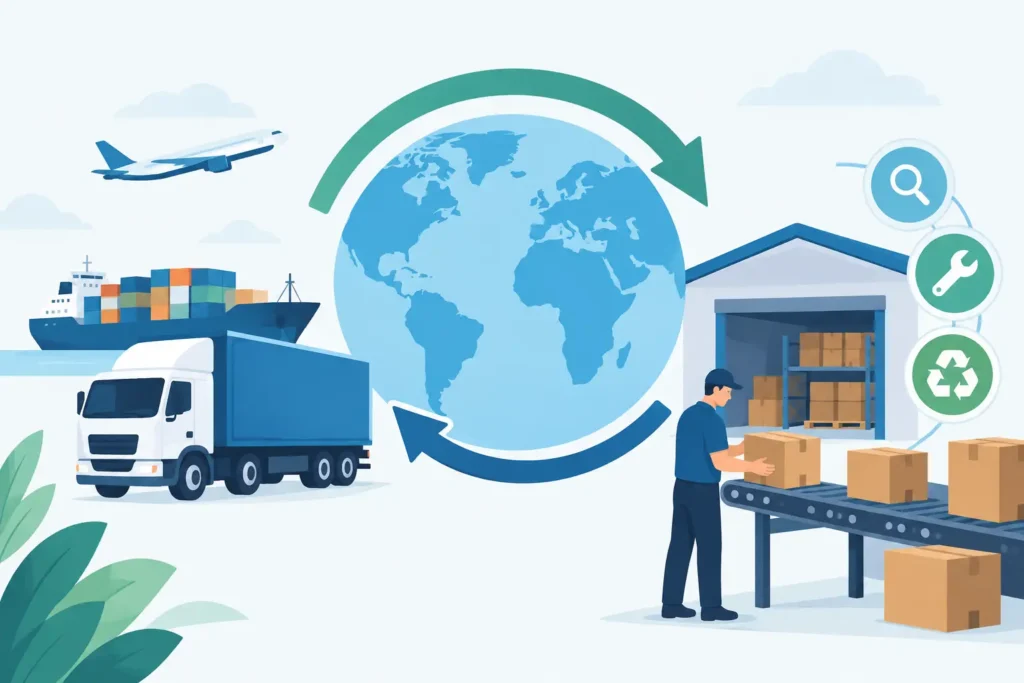
A returned shipment can cost far more than its original outbound freight. It may sit at a port awaiting customs direction, lose resale value in storage, or generate duties twice if the paperwork does not clearly establish its status. This reverse logistics guide explains how importers, exporters, and supply chain managers can move returned cargo with control, particularly across India, the UAE, and international trade lanes.
What Reverse Logistics Means in International Freight
Reverse logistics is the managed movement of goods from the customer, project site, distributor, or overseas market back to a warehouse, repair center, supplier, or approved disposal point. It includes more than customer returns. Recalled products, damaged freight, unsold inventory, reusable packaging, warranty items, exhibition cargo, and equipment returning after a temporary export can all enter the reverse supply chain.
For domestic deliveries, a return may be as simple as collecting a carton and issuing a credit. International returns demand more planning. The shipment may cross borders, require export clearance from the country where it is located, and need a new import declaration at destination. The commercial value, original shipment details, duty treatment, and cargo condition can all affect cost and clearance time.
The goal is not always to bring goods back to the original factory. Depending on the cargo type and commercial value, the best outcome may be repair near the destination, resale through a local channel, consolidation at a regional warehouse, recycling, or controlled destruction. The right route depends on the value that can still be recovered after freight, duties, handling, and storage.
Why Returns Become Expensive Across Borders
The most common reverse-logistics problem is treating a return as a routine new shipment. A forward shipment is normally planned with a buyer, invoice, Incoterms, and import process already defined. A return often begins after a delivery issue, quality concern, or contract change, when documents and decision-makers are scattered across several locations.
Customs authorities need a clear explanation of why cargo is moving. If goods are being returned to the original exporter, documents should connect the return to the original import or export wherever possible. Serial numbers, airway bill or bill of lading references, original invoices, packing lists, and proof of duties paid can be valuable. Without this evidence, the cargo may be assessed as a fresh import rather than a returned item.
Cost also rises when goods are held while instructions are finalized. Port, airport, terminal, and warehouse storage charges can accumulate quickly. For temperature-sensitive, high-value, or project-related cargo, delay also increases the risk of damage, missed production schedules, or contractual disputes.
Build a Reverse Logistics Policy Before a Return Happens
A practical policy gives customer service, warehouse teams, finance, procurement, and logistics providers the same decision path. It should specify which returns need authorization, which goods can be repaired or resold locally, and when cargo must be sent back to the supplier.
Start by grouping products according to risk and value. High-value electronics, automotive parts, machinery components, medical equipment, and specialized project cargo usually justify individual review. Low-value, bulky, or damaged goods may cost more to transport internationally than they are worth. In those cases, local disposal or a regional recovery option may be commercially smarter, provided it complies with local regulations and brand requirements.
Your policy should also establish a return authorization process. Each approved return should receive a reference number linked to the original sale, product description, reason for return, cargo value, condition, and destination instructions. This creates a traceable record before the shipment reaches a carrier, customs broker, or warehouse.
Set Decision Rules for Each Return
A return decision should answer four questions: Can the item be resold or repaired? Is it eligible for duty relief, refund, or re-export treatment? What is the fully landed cost of recovery? Who is responsible for freight and customs charges?
Do not use the original sales invoice without review. The declared value for customs must accurately reflect the transaction and condition of the returned goods. A returned product may have a different customs value than a new item, especially where it is damaged, used, or being sent for repair. Incorrect valuation can create clearance delays and compliance exposure.
Documentation That Supports Faster Clearance
Reverse movements need documents that tell a consistent story. The exact requirements vary by country, commodity, and reason for return, but the file should generally include the commercial invoice, packing list, transport document, return authorization, and a written statement explaining the purpose of the shipment.
Where available, include copies of the original export or import declaration, original airway bill or bill of lading, proof of previous duty payment, serial-number lists, photographs of damaged cargo, and repair reports. For warranty returns, a manufacturer authorization or warranty claim can help establish why the product is moving.
The invoice description should be specific. “Returned goods” alone rarely gives customs enough information. A better description identifies the product, model or serial number, condition, original country of origin, and reason for return, such as “used industrial pump returned to manufacturer for warranty inspection.”
For goods moving between the UAE and India, customs treatment should be confirmed before collection. Whether cargo can be re-exported, re-imported, temporarily admitted, repaired, or sent to a bonded facility depends on the transaction details. Early review by an experienced customs team helps avoid sending freight to the wrong location or using documents that do not match the intended procedure.
Choose the Right Return Transport Model
The most cost-effective transport method depends on urgency, shipment size, cargo condition, and recovery value. Air freight is often suitable for urgent spare parts, high-value items, and compact warranty returns. Ocean freight may be the better choice for palletized inventory, heavy machinery, or larger volumes where transit time is less critical. Road freight can support regional collections and cross-border flows where service coverage allows.
Consolidation is especially useful when multiple customer returns are moving from the same market. Instead of shipping each carton separately, goods can be collected at a local point, inspected, documented, and forwarded in a scheduled consolidated shipment. This reduces per-unit freight cost and gives the shipper a chance to decide whether certain items should be repaired, restocked, or disposed of locally.
However, consolidation is not automatically the right answer. A shipment containing hazardous goods, sensitive electronics, products with different customs statuses, or urgent production parts may need separate handling. Combining cargo can save freight but complicate documentation and delay the entire batch if one item has a clearance issue.
Protect Cargo Value During Collection and Return
Returned goods are often more vulnerable than new outbound freight. Original packaging may be missing, cartons may be weakened, and the cargo may have been opened or used. Collection teams should inspect the shipment, record visible damage, confirm piece counts, and apply packaging suitable for the selected mode of transport.
For machinery, automotive parts, and project equipment, photographs and serial-number verification are useful before cargo is loaded. For luxury vehicles and specialized equipment, secure loading, lashing, and condition reporting are essential. Cargo insurance should also be reviewed. A standard outbound policy may not automatically cover every reverse movement or the full value of used or damaged goods.
Shipment visibility matters just as much on the way back. Your operations team should know when cargo has been collected, delivered to the export facility, cleared, departed, arrived, and released to the receiving warehouse. Clear status updates allow customer service and inventory teams to plan credits, replacements, repairs, or resale without waiting for manual confirmation.
Measure Recovery, Not Just Return Cost
Freight cost is only one part of reverse-logistics performance. A low-cost route is not a success if the cargo arrives too late to be repaired, resold, or used in production. Track the total cost of each return, including pickup, packaging, freight, customs clearance, storage, inspection, repair, disposal, and recovered value.
Useful measures include return cycle time, percentage of goods recovered for resale or repair, customs hold rate, damage rate during return transit, and cost per returned unit. These figures help identify recurring issues. For example, repeated damage from one destination may point to weak packaging, while frequent customs delays may show that return documents are being prepared too late.
Mass Freight Forwarding can support return cargo with coordinated freight movement, customs handling, warehousing, and transport options across India, the UAE, and global destinations. The most effective programs combine this operational support with clear internal ownership from the shipper.
A controlled return begins before the pickup is booked. Confirm the commercial decision, document the cargo condition, verify the customs route, and select transport based on the value you can recover. That discipline keeps returned goods from becoming stranded inventory and gives your supply chain a practical way to protect both cost and customer trust.