
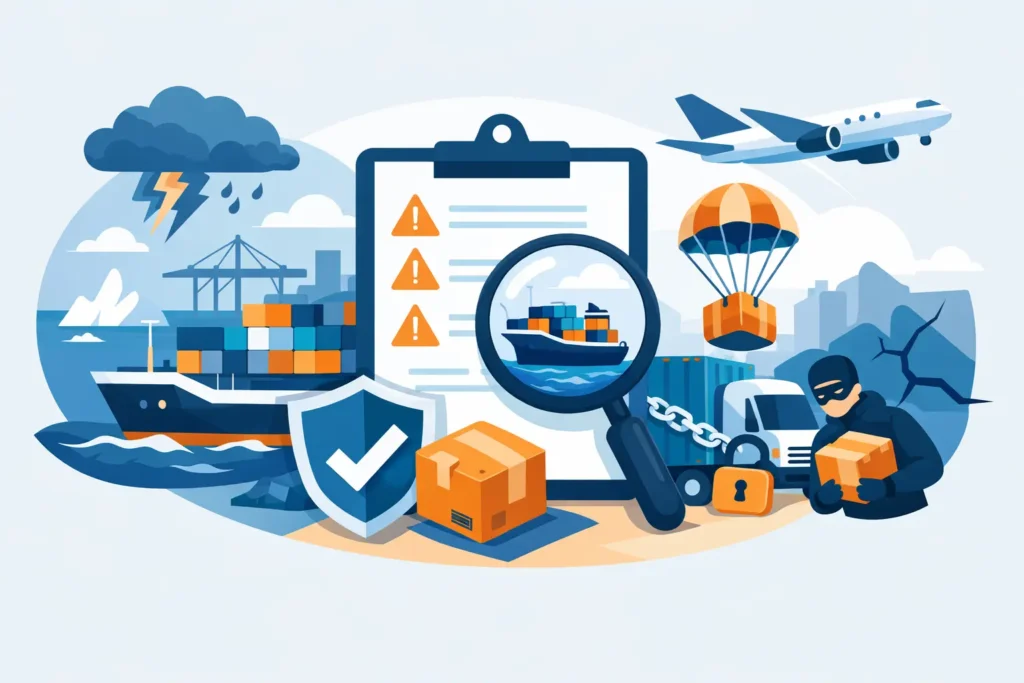
A container can be packed correctly, collected on schedule, and still become a costly problem before it reaches the buyer. A missed customs detail, a port rollover, or moisture inside the container can affect delivery commitments, cash flow, and customer confidence. Understanding the top freight risks for exporters helps businesses make better decisions before cargo leaves the warehouse, not after a disruption has already occurred.
For exporters moving cargo from India, the UAE, or other global trade hubs, risk management is not only about choosing the lowest freight rate. It involves matching the transport method, packaging, documentation, insurance, and delivery terms to the actual shipment. The right approach depends on cargo value, destination, transit time, and how much control the exporter retains over the movement.
Top Freight Risks for Exporters: Where Problems Begin
Customs and documentation errors
Incorrect or incomplete documentation is one of the most avoidable causes of freight disruption. A mismatch between the commercial invoice, packing list, certificate of origin, bill of lading, or export declaration can lead to customs holds, inspections, penalties, or rejected clearance.
Commodity descriptions deserve particular attention. Broad descriptions such as “parts” or “equipment” may be insufficient for customs authorities, especially where product classification, material composition, end use, or controlled goods rules apply. Incorrect HS codes can also affect duty treatment at destination and create disputes with the buyer.
Exporters should establish a document review process before cargo is handed to the carrier. Confirm consignee details, Incoterms, quantities, values, country of origin, and cargo descriptions against the purchase order. For India-UAE and UAE-India movements, local customs requirements and trade documentation must be checked early, particularly when goods need permits, registrations, or preferential origin treatment.
Delays, congestion, and schedule changes
Ocean and air freight schedules are operational targets, not guarantees. Vessel rollovers, blank sailings, port congestion, weather events, airline capacity constraints, labor disruptions, and transshipment delays can all extend transit time. A shipment that misses a retail launch, production window, or contractual delivery date may create costs far beyond the freight bill.
The practical response is to plan backward from the required delivery date rather than the intended departure date. Build time for cargo readiness, customs filing, port cutoffs, security checks, and destination clearance. For time-sensitive cargo, exporters may need to consider air freight, sea-air options, or split shipments, even though these choices can increase transport cost.
Visibility also matters. Regular milestone updates allow exporters to notify buyers early, adjust inventory plans, and act before a delay becomes a relationship issue. A reliable freight forwarder should explain what has changed, what it means for the cargo, and which recovery options are available.
Cargo damage, loss, and poor packaging
Cargo is exposed to handling, vibration, stacking pressure, temperature changes, moisture, theft, and shifting during transit. These risks vary by mode. Ocean shipments may face condensation and long port dwell times. Air freight can involve frequent handling and dimensional restrictions. Road freight may be affected by rough routes, insecure loading, or transfer points.
Packaging must be designed for the full transport chain, not only for warehouse storage. Export cartons should withstand stacking and handling, pallets should be properly secured, and fragile goods should have suitable internal protection. For machinery, project cargo, vehicles, and oversized items, professional lashing and securing are essential. Poorly secured cargo can damage adjacent freight, delay loading, and create liability issues.
Container condition should be checked before loading. Exporters should look for holes, odors, wet floors, damaged door seals, and signs of contamination. For moisture-sensitive goods, desiccants, liners, and moisture barriers may be appropriate. Loading photographs, packing records, and seal details provide useful evidence if a claim becomes necessary.
Inadequate cargo insurance
Many exporters assume that a carrier will fully compensate them if cargo is damaged or lost. In practice, carrier liability is often limited by international conventions, carriage terms, and the cause of the incident. The amount recoverable may be much lower than the cargo’s commercial value.
Cargo marine insurance can protect against defined transit risks, but coverage must be selected carefully. The policy should reflect the cargo type, route, shipment value, packing method, and agreed Incoterms. High-value electronics, luxury vehicles, temperature-sensitive products, and project cargo may require more specific coverage and handling controls.
Insurance is not a substitute for careful packing or accurate declarations. Claims can be weakened when cargo is inadequately packed, the value is understated, or damage is not reported promptly. Exporters should understand the policy conditions before shipment and preserve inspection reports, photographs, invoices, and survey documentation when an incident occurs.
Commercial and Operational Risks That Affect Margin
Freight cost volatility and unexpected charges
A low quoted freight rate does not always represent the total cost of shipping. Fuel adjustments, peak season surcharges, port storage, demurrage, detention, inspection fees, destination charges, and inland delivery costs can materially change the final landed cost. Exchange-rate movements may add further pressure on international shipments.
This risk is higher when cargo readiness is uncertain or documentation is delayed. A container held at port can quickly accumulate storage and equipment charges. Exporters should request clear rate validity, identify included and excluded charges, and understand free-time conditions before booking. The lowest rate can be expensive if it leaves little room for service recovery or exposes the shipment to avoidable port costs.
Incoterms and payment exposure
Incoterms define which party arranges transport, bears risk at different stages, and handles specific costs. They do not determine every contractual obligation, nor do they replace a clear sales agreement. Confusion over terms such as EXW, FCA, FOB, CIF, DAP, and DDP can lead to disputes over export clearance, insurance, destination charges, or the point at which risk transfers.
The chosen term should fit the exporter’s level of control and the buyer’s capabilities. For example, offering delivered terms may improve the buyer experience, but it can place more operational and customs responsibility on the exporter. Conversely, handing over control too early may limit the exporter’s ability to manage transit quality and prove shipment performance.
Payment risk must be considered alongside freight risk. If goods are released before payment is secured, an exporter may face a collection problem even when transport has been completed correctly. Documentary collections, letters of credit, advance payments, or credit insurance may be relevant depending on the customer relationship and market.
Restricted goods and regulatory changes
Sanctions, export controls, product standards, dangerous goods rules, and destination import restrictions can change with limited notice. A product may be legally exportable from one country but require special approval, labeling, testing, or registration at destination.
This is particularly relevant for chemicals, batteries, food products, medical goods, electronics, dual-use equipment, and goods containing regulated materials. Screening the buyer, end user, route, and product requirements before booking reduces the risk of seizure, fines, and reputational damage. When regulations are unclear, exporters should seek specialist customs and compliance guidance instead of relying on assumptions from a previous shipment.
Building a More Controlled Export Process
Risk cannot be removed from international freight, but it can be managed through preparation and accountability. Start by creating a shipment checklist that covers product classification, documents, packaging, insurance, booking cutoffs, Incoterms, and destination requirements. Review it for every new buyer, product, or trade lane rather than treating all shipments alike.
It also helps to separate predictable risks from exceptional events. Documentation accuracy, packing quality, and cargo readiness are largely within the exporter’s control. Weather disruptions and port congestion are not, but their impact can be reduced through realistic lead times, contingency routing, and timely communication with customers.
For specialized cargo or recurring cross-border movements, working with an experienced forwarding partner provides practical support across booking, customs clearance, transport coordination, warehousing, and cargo protection. Mass Freight Forwarding helps exporters manage these moving parts across India, the UAE, and global trade lanes with solutions matched to cargo and delivery requirements.
The strongest export operations are not the ones that never face a delay or claim. They are the ones that identify exposure early, document every handoff, and have a clear plan for protecting the cargo, the customer relationship, and the margin when conditions change.