
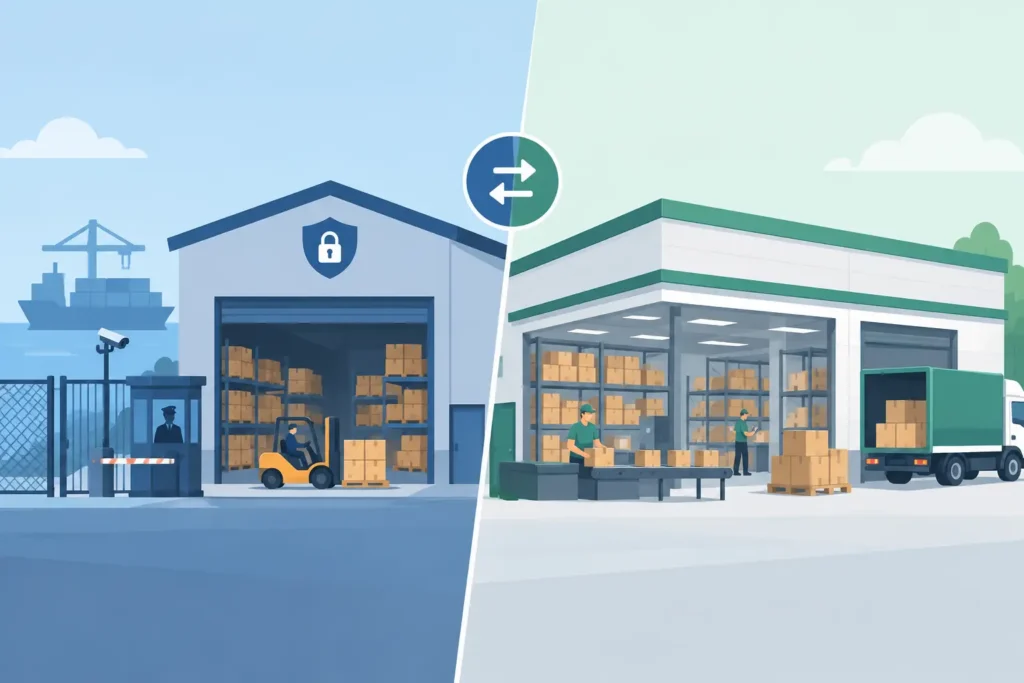
A container arriving at Jebel Ali or Nhava Sheva can create two very different operational problems. You may need to hold imported stock without paying duty until demand is confirmed, or you may need to pick, pack, and dispatch customer orders immediately. The bonded warehouse versus fulfillment center decision starts with that distinction: customs control versus order execution.
For importers, exporters, and supply chain managers moving cargo through the UAE, India, and global trade lanes, choosing the wrong facility model can add avoidable duty costs, handling delays, and inventory blind spots. The right choice depends on where your goods are in the trade cycle, who owns the next movement, and how quickly inventory needs to reach its final buyer.
Bonded Warehouse Versus Fulfillment Center: The Core Difference
A bonded warehouse is a customs-authorized facility where imported goods can be stored under customs supervision before import duties and taxes are paid. The cargo remains in bond until it is cleared for local consumption, re-exported, transferred under an approved procedure, or otherwise handled according to customs rules.
A fulfillment center is designed to process orders. It receives inventory, stores it, picks individual products or cartons, packs shipments, applies labels, and dispatches goods to retail locations, distributors, or end customers. Its value comes from speed, accuracy, inventory visibility, and delivery performance.
In practical terms, a bonded warehouse helps manage the financial and compliance side of cross-border inventory. A fulfillment center helps manage the commercial side of getting products to customers. Some operations need one. Many growing import businesses need both, either as separate facilities or as coordinated services within a broader logistics plan.
When a Bonded Warehouse Is the Better Fit
A bonded warehouse is particularly useful when inventory arrives before you are ready to sell it in the destination market. Rather than paying applicable import duty and taxes on the entire shipment at arrival, you can defer payment until goods are released from the facility for local distribution.
This can improve cash flow for businesses importing high-value stock, seasonal products, industrial equipment, spare parts, automotive components, or goods with uncertain demand. A company bringing a large shipment into the UAE, for example, may sell part of the stock locally while re-exporting the balance to regional markets. Goods that are re-exported may avoid local import duty, subject to the applicable customs procedures and documentation.
Bonded storage also gives businesses time to make better inventory decisions. An importer can consolidate cargo, prepare documents, await purchase orders, arrange onward transport, or assess whether stock should enter India, the UAE, or another market. For project cargo and specialized equipment, controlled storage can be valuable when site readiness and customs clearance dates do not align.
However, bonded storage is not a way to set goods aside and forget about them. Customs requirements, stock records, permitted handling activities, time limits, licensing conditions, and release procedures must be managed carefully. The exact rules vary by jurisdiction, facility type, commodity, and customs authority. Experienced customs coordination is essential, especially where goods will be split, re-exported, or transferred across borders.
Key Advantages of Bonded Storage
The main commercial benefit is duty deferral. This can reduce the working-capital pressure of importing inventory in bulk. Bonded facilities can also support re-export planning, controlled inventory holding, and consolidation before onward shipping.
The trade-off is operational flexibility. A bonded facility is governed by customs controls, so access to stock and permitted activities may be more restricted than in standard commercial warehousing. If your priority is processing hundreds of small orders each day, a bonded warehouse alone may not provide the workflows, labor model, or systems required for fulfillment.
When a Fulfillment Center Makes More Sense
A fulfillment center is the stronger choice when products have already been cleared for sale in the local market and the business needs fast, repeatable order processing. This is common for e-commerce brands, distributors supplying multiple retail accounts, manufacturers shipping spare parts, and companies replenishing dealers across a region.
Instead of storing pallets until a customs decision is made, fulfillment operations turn inventory into outbound orders. Staff receive goods, check quantities and condition, put items away in assigned locations, pick products against orders, pack them to the required standard, and prepare them for courier, truck, air freight, or customer collection.
The difference is visible in the performance measures. A bonded warehouse often focuses on customs-compliant stock control, cargo security, and release accuracy. A fulfillment center measures order turnaround, pick accuracy, packing quality, returns handling, and on-time dispatch. Neither is better in every situation. They serve different points in the supply chain.
For a business selling fast-moving products across the UAE or India, fulfillment can reduce the internal workload of managing daily orders. It can also provide a more reliable customer experience when inventory data, shipping labels, and carrier handoffs are properly coordinated. But the goods generally need to be customs-cleared before routine domestic fulfillment begins, and duty and tax costs must be included in the landed-cost model.
What a Fulfillment Center Should Handle
A capable fulfillment operation should do more than provide shelf space. It should support inbound receiving, inventory checks, pallet and carton storage, order picking, packing, labeling, dispatch coordination, and reporting. Depending on the cargo and sales model, it may also handle kitting, relabeling, returns, quality checks, and retailer-specific preparation.
The service is especially valuable when your team should be focused on selling, sourcing, or serving customers rather than preparing shipments. Still, fulfillment has a cost structure of its own. Storage fees, handling charges, per-order pick and pack fees, packaging, and delivery charges should be reviewed against order volume and product profile.
A Common Hybrid Model: Bond First, Fulfill Later
The most effective answer is often not a strict choice between a bonded warehouse and a fulfillment center. Importers can use bonded storage as the first stage, then release stock in planned quantities for domestic fulfillment once demand is clear and duties are paid.
Consider a company importing consumer electronics through the UAE for both local sales and regional re-export. It may place the full shipment in a bonded facility, allocate a portion for confirmed UAE orders, and re-export the remainder to other markets. The goods intended for UAE customers can be customs-cleared in batches and moved into a fulfillment operation for rapid order dispatch.
This approach can balance cash flow with delivery speed. It also prevents a business from clearing an entire shipment into one market when its actual sales are spread across several countries. The process requires accurate stock segregation, customs documentation, and communication between the warehouse, freight forwarder, customs broker, and fulfillment team.
Questions to Ask Before Choosing a Facility
Start with the destination of your inventory. If the final market is uncertain or some goods may be re-exported, bonded storage deserves serious consideration. If the goods are already committed to local customers and need to ship daily, fulfillment capacity should be the priority.
Next, look at your duty exposure and inventory value. Duty deferral can be significant for high-value stock or large-volume imports, but it may be less meaningful for lower-value goods that move quickly after arrival. Also consider how long inventory is likely to remain in storage. Long dwell time can create storage costs that offset some of the cash-flow benefit.
Order profile matters just as much. Full-pallet movements to a few distributors are different from hundreds of single-item e-commerce shipments. A facility built for container unloading and customs control may not be efficient for individual parcel packing. Conversely, a highly active fulfillment center may not be appropriate for cargo still awaiting a customs decision.
Finally, assess the quality of operational control. Ask how inventory is recorded, how discrepancies are handled, what reporting is available, which customs processes are supported, and how cargo moves from port or airport to storage and onward delivery. Visibility is not only a convenience. It helps prevent delays, stock loss, and costly clearance errors.
Build the Warehouse Plan Around the Trade Flow
The best facility decision follows the movement of the cargo, not a generic warehousing label. Map the shipment from supplier pickup through air freight, ocean freight, or land transport; arrival clearance; storage; order processing; and final delivery. Then identify where customs responsibility ends and customer-order activity begins.
Mass Freight Forwarding supports businesses moving cargo between India, the UAE, and international markets with freight coordination, customs handling, warehousing, and onward distribution planning. For complex shipments, bringing these activities under a coordinated operating plan can reduce handoffs and give decision-makers a clearer view of cargo at every stage.
Before your next shipment departs, confirm whether the inventory needs time under customs control or needs to reach buyers without delay. That single decision will point you toward the facility model that protects both your cash flow and your customer commitments.