
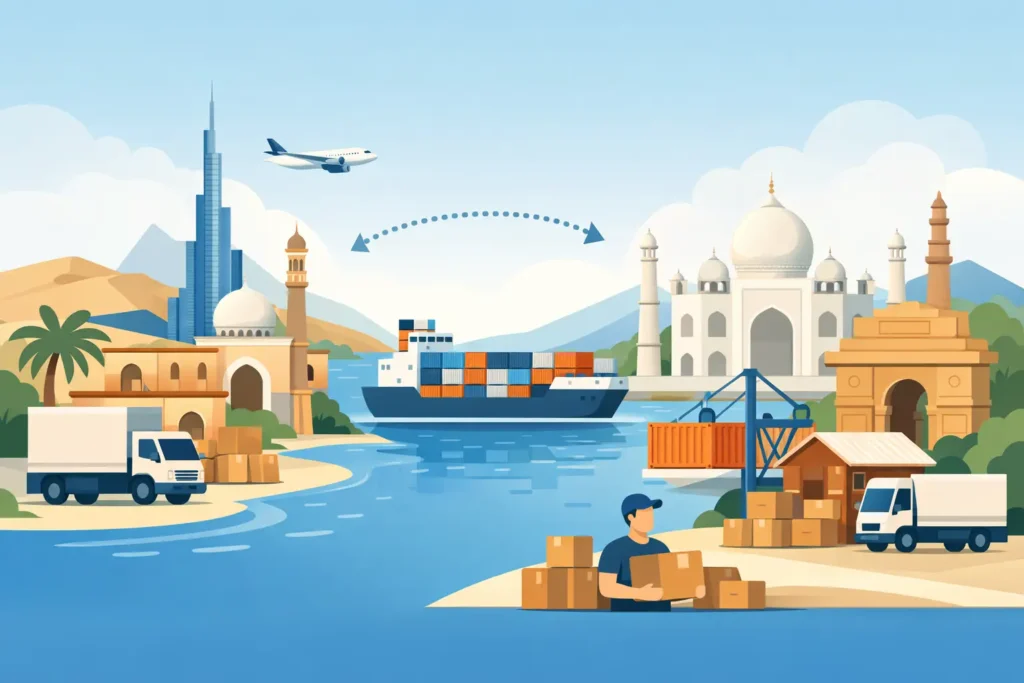
A shipment can leave a factory on time, arrive at the right port, and still miss its delivery date because no one planned the final handover, clearance requirements, or local transport. This door to door shipping guide explains how businesses can move cargo from origin to consignee with one coordinated logistics plan, particularly across UAE, India, and global trade lanes.
Door-to-door service is not simply freight plus a truck at each end. It is a managed chain of collection, export handling, international transport, customs clearance, import handling, and final delivery. When each stage is aligned before cargo moves, importers and exporters gain better cost control, fewer document issues, and clearer responsibility for delivery.
What door-to-door shipping includes
In a door-to-door shipment, the freight forwarder coordinates cargo pickup from the supplier, warehouse, factory, or seller and delivers it to the buyer’s nominated address. Depending on the route and cargo type, the service may use air freight, ocean freight, road freight, or a combination of modes.
The scope should be clearly stated in the quotation. A complete service commonly covers origin pickup, packing or inspection coordination where required, export customs procedures, terminal handling, international freight, import customs clearance, local charges, and delivery to the final destination. Cargo insurance, warehousing, crating, lashing, and special equipment may be added where the shipment demands it.
The practical advantage is accountability. Instead of arranging separate providers for collection, freight, clearance, and final-mile delivery, the shipper works with one logistics partner coordinating the handoffs. That does not remove the customer’s responsibility to provide accurate commercial documents or meet import rules, but it substantially reduces the risk of gaps between service providers.
Door to door shipping guide: start with the cargo and route
The right shipping plan begins with facts, not a generic rate request. Provide the cargo description, commodity code if available, number of packages, dimensions, gross weight, cargo value, pickup address, final delivery address, and ready date. For recurring shipments, include expected volume and shipping frequency.
Cargo characteristics determine the transport method. Time-sensitive samples, spare parts, and high-value products may be better suited to air freight. Larger commercial consignments generally move more economically by ocean freight, either as a full container load or through LCL groupage. Road transport can be the preferred option for regional GCC movements, while project cargo, machinery, and vehicles may require RORO, break bulk, flat racks, or specialized trailers.
The route also changes the cost and transit profile. A shipment from Dubai to Mumbai may have different documentation, port handling, and delivery constraints than a shipment arriving in Jebel Ali from Europe and moving onward to an inland destination in the UAE. Ask for a route-specific plan rather than relying on a transit time quoted for port-to-port freight alone.
Confirm the delivery term before booking
Commercial terms decide who pays, who manages each leg, and where risk transfers between buyer and seller. Incoterms are useful, but they must be used correctly and matched to the shipment mode.
For example, under DDP, the seller takes on broad obligations, including import clearance and duties where permitted. This can be attractive to a buyer, but it requires the seller or its appointed agent to have the ability to clear goods legally in the destination country. Under DAP, the seller delivers to the named destination while the buyer typically manages import clearance and taxes. For many commercial shipments, a clear division of responsibility is more valuable than choosing the term that sounds most convenient.
Before cargo collection, confirm who is the importer of record, who pays duties and taxes, who is authorized to clear the goods, and whether destination unloading is included. These details prevent avoidable disputes once the cargo reaches the destination.
Documentation and customs compliance drive delivery performance
Freight capacity can be booked quickly. Correct customs paperwork takes more discipline. The commercial invoice, packing list, bill of lading or air waybill, and any certificates required for the commodity should match in product description, quantity, value, and consignee details.
India and the UAE both have specific customs and regulatory requirements that may vary by product. Food items, cosmetics, electronics, chemicals, medical goods, batteries, machinery, and controlled products can require additional approvals, registrations, test reports, or certificates. A vague invoice description such as “parts” or “general cargo” invites customs questions. A precise description, correct tariff classification, and support for the declared value help clearance move more predictably.
Do not treat customs clearance as a last-minute port activity. Review documents before the goods depart, especially for first-time products, new suppliers, high-value cargo, or shipments entering free zones. If customs holds the shipment for clarification, the freight may already be at destination while storage and demurrage exposure begins to grow.
Build the quote around total landed cost
A low freight rate is not always a low shipping cost. Importers should evaluate the full landed cost: origin collection, export charges, freight, insurance, destination handling, customs brokerage, duty, tax, delivery, and any special service charges.
Ask whether the quoted price includes terminal handling, documentation, customs filing, delivery appointment fees, waiting time, forklift support, and unloading. For ocean freight, understand whether the shipment is FCL or LCL. LCL can be cost-effective for smaller volumes, but it involves consolidation and deconsolidation activities that may extend handling time. FCL offers more control for containerized cargo, though the shipper must use the space efficiently.
Air freight is usually faster, but chargeable weight can make lightweight, bulky shipments more expensive than expected. Ocean freight takes longer but often offers stronger economics for larger loads. The best choice depends on inventory urgency, product margin, shipment size, and the cost of a delayed delivery.
Cargo marine insurance should also be considered as part of cost planning, not an optional afterthought. Carrier liability can be limited and may not reflect the commercial value of the goods. Appropriate coverage provides a clearer path if cargo is damaged, lost, or affected by a covered transit event.
Prepare cargo for the real journey, not only the pickup
Packaging needs to withstand loading, unloading, port or airport handling, and local delivery conditions. Export-grade cartons, pallets, crates, moisture protection, corner guards, and secure strapping should be selected based on the commodity and mode of transport.
For machinery, oversized equipment, and fragile products, the loading plan matters as much as the package. Cargo lashing, blocking, bracing, and weight distribution protect the shipment inside a container or on a flat rack. Incorrect securing can cause damage, delays at terminals, or refusal by carriers.
Label every package with the consignee name, destination, package number, handling symbols, and any required hazard markings. For temperature-sensitive or regulated goods, verify that the transport chain and destination facility can support the necessary conditions before booking.
Keep visibility and contingency planning in the process
Door-to-door shipping works best when the forwarder provides practical milestones: cargo collected, export cleared, departed, arrived, import documents submitted, customs released, and out for delivery. Supply chain managers can then update customers, plan receiving labor, and respond early when a delay develops.
A reliable plan also anticipates exceptions. Vessel schedule changes, airline capacity constraints, weather events, customs inspections, port congestion, and consignee delivery restrictions can affect transit. The goal is not to promise that disruptions never occur. It is to identify alternatives quickly, communicate accurately, and protect the cargo and delivery commitment where possible.
For shipments between India and the UAE, local operational knowledge matters. A partner with customs handling capability and transport coordination in both markets can address documentation questions, destination charges, delivery access, and clearance requirements with less back-and-forth. Mass Freight Forwarding can tailor door-to-door cargo plans around commercial freight, vehicles, LCL shipments, project logistics, and specialized cargo requirements.
A better shipment begins before pickup
The strongest door-to-door shipments are planned when the purchase order is issued, not when the cargo is already packed. Share your delivery deadline, cargo details, commercial terms, and destination requirements early. That gives your logistics partner time to select the right mode, validate documents, arrange safe handling, and protect a delivery date that matters to your business.