
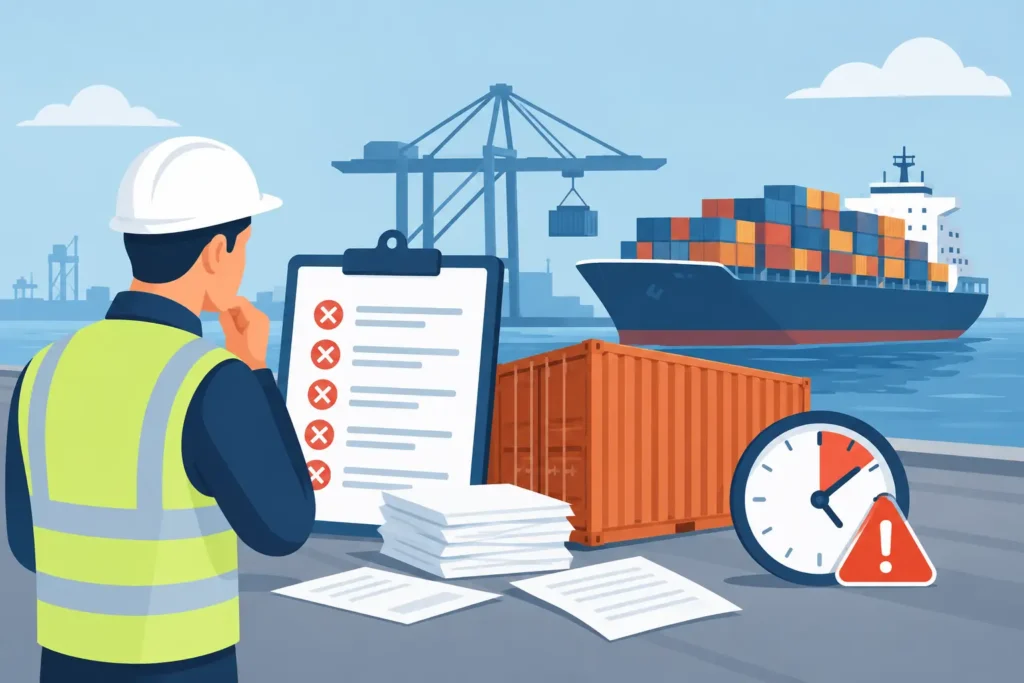
A shipment can arrive at the port or airport exactly on schedule and still become an expensive problem. A missing product detail, an incorrect customs value, or a certificate submitted too late can stop cargo from moving while storage, demurrage, and business disruption build. Most import compliance mistakes are avoidable, but only when compliance is treated as part of shipment planning rather than paperwork to finish after goods have departed.
For businesses importing into the UAE, India, or other global markets, the requirements can vary by product, origin, transaction value, and port of entry. The right approach is not to apply one checklist to every shipment. It is to verify the details that apply to the cargo, the trade lane, and the buyer before booking freight.
1. Using the Wrong HS Code
The Harmonized System code determines how customs authorities classify a product. That classification influences duty rates, taxes, permits, restrictions, and documentation requirements. A code chosen from a supplier invoice, a previous shipment, or a broad online description may look reasonable but still be incorrect.
The risk is not limited to paying the wrong duty. An inaccurate HS code can trigger a customs query, reassessment, penalty, or post-clearance audit. It can also result in a product being treated as restricted when the importer did not expect a permit requirement.
Classification should be based on the product’s material, function, composition, and intended use. For machinery, automotive parts, electronics, chemicals, food items, and textiles, small differences in specifications can change the classification. Keep technical sheets, catalogs, ingredient lists, and manufacturer declarations available to support the selected code.
2. Declaring an Incomplete or Inaccurate Customs Value
Customs value is more than the unit price shown on a commercial invoice. Depending on the applicable valuation rules and Incoterms, customs may need to consider freight, insurance, packing, assists, royalties, commissions, or other costs connected to the imported goods.
Under-declaring value to reduce duties is a serious compliance failure. But unintentional errors happen as well, particularly when procurement, finance, and logistics teams work from different documents. For example, a buyer may declare the supplier invoice value without realizing that separately invoiced tooling or license fees must be considered.
Make sure the commercial invoice clearly identifies the buyer and seller, currency, payment terms, Incoterms, accurate product descriptions, quantities, and line-item values. The declared value should be consistent with purchase orders, payment records, freight documents, and insurance details. If customs asks questions, a well-organized document trail helps resolve them faster.
3. Writing Vague Product Descriptions
Descriptions such as “parts,” “samples,” “accessories,” or “general merchandise” create unnecessary scrutiny. Customs officers need enough information to identify what the goods are and determine whether they are correctly classified, valued, and permitted.
A useful description states what the item is, what it is made of, and where relevant, what it is used for. “Stainless steel fasteners for industrial pumps” is much clearer than “machine parts.” “Men’s knitted cotton T-shirts” gives far more useful information than “garments.”
Descriptions must also match across the commercial invoice, packing list, bill of lading or air waybill, certificate of origin, and customs declaration. Inconsistent wording is a common reason for a query, even when the shipment itself is legitimate.
4. Assuming Origin Is the Same as Shipping Location
Country of origin is generally where a product was manufactured or substantially transformed, not simply the country from which it was shipped. Goods consolidated in the UAE, for example, may have originated in China, India, Europe, or another market. Declaring the UAE as origin solely because the cargo was dispatched from Dubai can create a compliance issue.
Origin affects duty treatment, free trade agreement eligibility, labeling, anti-dumping measures, and sanctions screening. Preferential tariff benefits are not automatic. Importers must confirm that the product meets the relevant rules of origin and that the required proof is available.
This matters particularly for businesses moving cargo between India and the UAE, where trade documentation and product origin need careful coordination. Ask suppliers for origin declarations early, especially when goods are manufactured with components from multiple countries.
5. Missing Permits, Registrations, or Product Approvals
Many cargo delays occur because an importer discovers a regulatory requirement only after the goods reach the destination. The exact controls depend on the destination country and product category, but common examples include food and beverages, cosmetics, medical devices, pharmaceuticals, chemicals, batteries, telecom equipment, automotive products, and controlled or dual-use goods.
In the UAE, certain products may require registration or approvals from the relevant authority before import. In India, product-specific regulations can involve agencies responsible for standards, food safety, plant and animal health, drugs, or telecommunications. A freight booking confirmation does not mean the cargo is approved for import.
Check requirements before production is complete and well before cargo handover. This gives the importer time to obtain approvals, confirm labeling rules, arrange testing if needed, and decide whether a permit must be issued in the importer’s name. For project cargo or specialized equipment, compliance planning should begin even earlier because the documentation can be more complex.
6. Treating Incoterms as a Sales Detail Only
Incoterms set out responsibilities between the seller and buyer for transport, risk, and certain costs. They do not replace the importer’s obligation to make accurate customs declarations. Still, unclear Incoterms frequently lead to missing documents, disputes over freight costs, and incorrect customs values.
For example, an importer using CIF, CPT, or DAP terms should understand which charges are included up to the named destination and which charges appear separately. With EXW shipments, the buyer may be responsible for export arrangements that the supplier assumed were someone else’s responsibility. DDP can be useful in some situations, but it requires close attention to who acts as importer of record and whether that arrangement is legally appropriate in the destination country.
Use the full Incoterm and named place, such as “CIP Dubai Airport” or “FOB Nhava Sheva Port,” on the commercial invoice and contract. This prevents uncertainty when freight, insurance, and local charges need to be allocated for customs purposes.
7. Failing to Screen Parties and Cargo Restrictions
Compliance is not only about duties and documents. Importers must also consider trade controls, sanctions, denied-party restrictions, and end-use concerns. Screening should cover suppliers, buyers, consignees, intermediaries, and where appropriate, the cargo’s final user.
The level of review depends on the route, commodity, transaction, and countries involved. A routine consumer-goods shipment may require a different process from electronics, industrial machinery, chemicals, or equipment that could have controlled applications. When red flags appear, such as unusual payment arrangements, a changed consignee, or vague end-use information, pause and investigate before the cargo moves.
A documented screening process protects the business and gives procurement, sales, and logistics teams a clear escalation path. Speed matters in freight, but moving questionable cargo quickly is not a sound business decision.
8. Sending Documents Too Late
Even perfect documents can fail to prevent delays if they arrive after the shipment. Late invoices, packing lists, certificates, permits, or arrival notices leave the customs broker and consignee with limited time to prepare declarations and respond to questions.
Document timing is especially critical for air freight, where cargo may arrive within days, and for LCL shipments, where release processes and destination charges can become more complicated if clearance is not arranged promptly. For ocean freight, delays can lead to port storage and container demurrage or detention, depending on the circumstances.
Set a document cutoff before departure. The exporter should send final shipping documents promptly, while the importer or appointed customs representative verifies them before arrival. If there is a discrepancy, correct it before it becomes a customs hold.
Build Compliance Into the Shipment Plan
The most effective way to reduce import compliance mistakes is to assign ownership before the purchase order is issued. Procurement should confirm supplier information and Incoterms. Product teams should provide technical specifications. Finance should validate transaction values. Logistics teams should coordinate documents, freight timing, and clearance instructions.
For recurring imports, create a shipment profile for each product category that records the approved HS code, description, origin, typical valuation elements, required approvals, and supporting documents. Review it whenever the supplier, material, product design, origin, or trade lane changes. A code or permit that worked last year may not be appropriate for a revised product or a new destination.
Mass Freight Forwarding supports importers with coordinated freight movement and customs handling across India, the UAE, and global trade lanes. Early document review and route-specific planning give cargo the best chance of clearing efficiently, while helping businesses control avoidable costs.
The practical next step is simple: before your next shipment is booked, ask whether the customs file would clearly explain what the goods are, where they came from, what they are worth, and why they are allowed to enter. If the answer is uncertain, resolve it before the cargo begins its journey.