
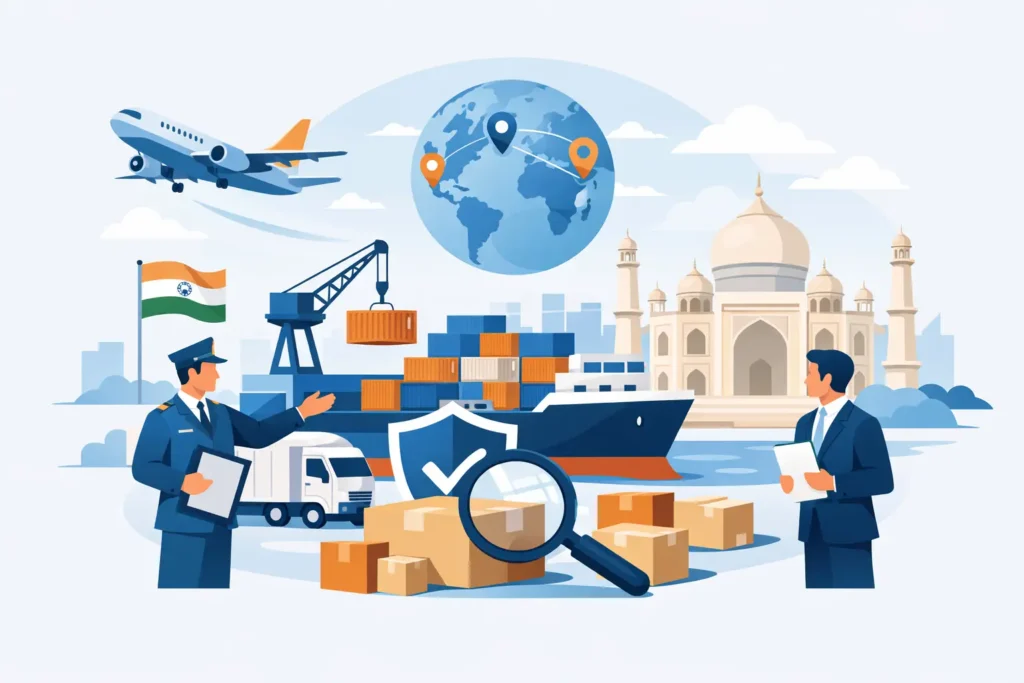
A shipment can arrive at an Indian port or airport on schedule and still lose days to a missing certificate, an incorrect HS classification, or a duty calculation that does not match the customs assessment. This India customs clearance guide is designed for importers, exporters, and supply chain teams that need to move cargo to or from India with greater control over cost, timing, and compliance.
Indian customs procedures are detailed because they protect revenue, regulate restricted goods, and support trade compliance. The practical goal is not simply to submit documents. It is to make sure the cargo description, value, classification, licenses, transport records, and declarations all tell the same accurate story.
How India Customs Clearance Works
India Customs operates under the Central Board of Indirect Taxes and Customs. Most commercial import and export filings are made electronically through the ICEGATE system, while supporting records may be uploaded through e-Sanchit. The importer, exporter, or appointed customs broker submits the declaration, and Customs determines whether the shipment can be cleared based on risk assessment, documents, duty payment, and any required examination.
For imports, the process normally begins after the carrier or airline files the Import General Manifest. The importer or customs broker files a Bill of Entry, which declares the goods, transaction value, country of origin, tariff classification, and applicable duties. Customs may clear the shipment based on electronic assessment, request additional information, or select the cargo for examination. Once duties are paid and an Out of Charge order is issued, the goods can be released from the port, airport, or bonded facility.
For exports, the equivalent core declaration is the Shipping Bill. After documentation and, where required, cargo examination are complete, Customs issues a Let Export Order. The shipment can then be loaded for departure. Exporters should also keep post-shipment documentation organized, especially when claiming eligible export incentives or meeting foreign buyer requirements.
The exact workflow depends on the commodity, mode of transport, port of entry, country of origin, and whether the goods are regulated. A standard container of general merchandise will follow a different path from pharmaceuticals, food products, machinery, chemicals, vehicles, or oversized project cargo.
India Customs Clearance Guide: Documents That Matter
Clearance delays often start before the cargo departs. Documents should be prepared early, reviewed against the purchase order and shipment details, and shared with the customs handling team before arrival whenever possible.
For a typical import, the essential file includes the commercial invoice, packing list, bill of lading or air waybill, importer’s Import Export Code, and relevant tax registration details. The commercial invoice should accurately show the buyer and seller, product description, quantity, unit price, currency, Incoterms, and total value. A vague description such as “machine parts” can create avoidable questions. A clear description that identifies the material, function, model, and use gives Customs a stronger basis for assessment.
Depending on the product, Customs may also require a certificate of origin, insurance certificate, technical literature, purchase order, product test report, catalog, or manufacturer declaration. Goods claiming preferential duty treatment under a trade agreement need a valid certificate of origin and must meet the applicable origin rules. A certificate alone may not be enough if the supporting documents do not establish eligibility.
Regulated cargo needs additional attention. Electronics may require Bureau of Indian Standards compliance. Food, cosmetics, and certain agricultural goods can require approvals or clearances from agencies such as the Food Safety and Standards Authority of India or plant and animal quarantine authorities. Pharmaceuticals, chemicals, wireless equipment, and medical devices may also need specialized permissions. Confirm these requirements before shipping, not while the cargo is waiting at the terminal.
Export documentation generally includes the commercial invoice, packing list, shipping bill, transport document, and any product-specific approvals. Exporters receiving payment in foreign currency should also coordinate with their authorized dealer bank and ensure their banking details and export records are correctly maintained.
Classification, Valuation, and Duty: The Main Cost Drivers
Three decisions shape most import clearance costs: HS classification, customs valuation, and origin. Errors in any one of these areas can lead to reassessment, additional duty, examination, penalties, or delayed delivery.
India uses the Harmonized System-based Customs Tariff to classify goods. The HS code determines the basic customs duty rate, whether a product is restricted, and whether additional duties or compliance requirements apply. Classification should be based on what the product is, how it works, what it is made from, and its intended function. The supplier’s suggested code is useful, but it should not be accepted without review.
Customs value is commonly based on the transaction value, subject to prescribed valuation rules. The declared value may be adjusted to include freight, insurance, assists, royalties, commissions, or other costs connected to the imported goods. Incoterms matter here. A CIF shipment and an EXW shipment can require different additions before the assessable value is finalized.
Import charges may include Basic Customs Duty, Social Welfare Surcharge, Integrated Goods and Services Tax, and, for certain products, compensation cess or other applicable levies. Rates change through tariff notifications and budget measures, so duty estimates should be checked close to shipment date. A low freight quote does not always mean a low landed cost if classification, origin, port charges, storage, or duty exposure have not been reviewed.
Avoid Delays Before the Cargo Reaches India
The fastest clearance is usually built before loading. Importers should send final shipping documents to their customs broker or freight forwarder in advance, rather than waiting until the vessel arrives or the flight lands. This gives the team time to verify document consistency, confirm the tariff code, calculate expected duties, and identify regulatory requirements.
Pay close attention to names, addresses, quantities, weights, marks and numbers, and product descriptions. Even small differences between the invoice, packing list, transport document, and Bill of Entry can trigger queries. For LCL groupage shipments, confirm that package counts and cargo details are correctly reflected in the consolidation records. For air freight, speed is valuable only when the clearance file is ready before arrival.
Port and airport free time is another operational issue. If Customs examination, document clarification, or duty payment takes longer than expected, demurrage, detention, and storage costs can build quickly. The right response is not to rush inaccurate paperwork. It is to identify likely clearance requirements early and keep decision-makers available to resolve Customs queries without delay.
Special Considerations for UAE-India Trade
Cargo moving between the UAE and India often benefits from well-established air and ocean freight connections, but the clearance requirements remain specific to the goods being shipped. For commercial imports into India, suppliers in the UAE should provide complete invoices and packing details, particularly where goods are re-exported, consolidated, or manufactured in another country.
Origin needs careful treatment. The country of export is not always the country of origin. If an importer seeks preferential treatment under the India-UAE Comprehensive Economic Partnership Agreement, the goods must qualify under its rules of origin and be supported by compliant origin documentation. A UAE invoice alone does not establish preferential origin.
Automotive shipments, high-value machinery, luxury goods, and project cargo need an added layer of planning. These shipments may require serial number records, technical specifications, valuation support, permits, specialized handling equipment, or a coordinated examination plan. For oversized or break bulk cargo, clearance timing must also align with port handling, transport permits, lashing arrangements, and final delivery requirements.
When to Use a Customs Clearance Partner
A capable customs clearance partner does more than file a Bill of Entry or Shipping Bill. The practical value comes from checking the clearance file before it becomes a problem, coordinating with carriers and terminal operators, tracking Customs queries, and keeping the consignee informed about duty payments and release status.
For recurring importers, a structured pre-arrival process can reduce uncertainty across every shipment. This may include approved product descriptions, classification records, a document checklist by commodity, landed-cost estimates, and escalation contacts for urgent cargo. For first-time importers, hands-on support can prevent basic but costly errors around registration, invoice format, or restricted goods.
Mass Freight Forwarding supports customs handling alongside air, ocean, land, warehousing, and door-to-door freight services for trade movements involving India, the UAE, and global markets. The right service model depends on the cargo profile, shipment volume, urgency, and compliance exposure.
Clearance should be treated as part of the transport plan, not as an administrative step after the cargo arrives. When documents are accurate, duty exposure is understood, and the customs team has visibility before arrival, your shipment has a far better chance of leaving the port on time and reaching its final destination as planned.