
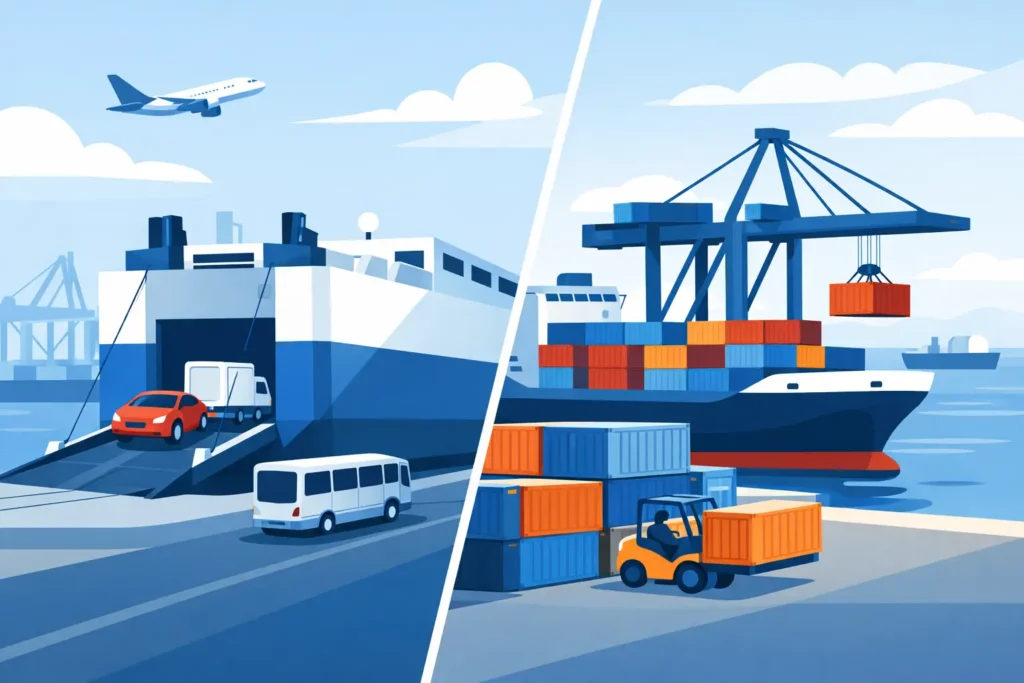
A vehicle ready to ship from Jebel Ali to India does not automatically belong in a container. Nor is RORO or container shipping simply a question of choosing the lower freight rate. The right method depends on whether the cargo can move under its own power, how much protection it needs, the ports available on the route, and the total cost of getting it cleared and delivered at destination.
For importers, exporters, automotive dealers, and supply chain managers moving cargo between the UAE, India, and global markets, this decision affects more than ocean freight. It can change packing requirements, port handling, transit predictability, cargo exposure, and customs documentation. A good shipping plan looks at the full movement from pickup through final delivery, not only the vessel booking.
RORO or Container Shipping: The Core Difference
RORO means roll-on/roll-off. Vehicles and self-propelled machinery are driven onto a purpose-built vessel, secured in designated decks, and driven off at the destination port. This method is commonly used for cars, SUVs, trucks, buses, tractors, construction equipment, and other wheeled cargo that is operational.
Container shipping places cargo inside a sealed steel container, usually a 20-foot or 40-foot unit. A vehicle may be loaded into the container and secured with lashing equipment, while non-vehicle cargo can be palletized, crated, or packed according to its handling requirements. Shippers may book a full container load, or FCL, when they need an entire unit, or less-than-container load, or LCL, for smaller compatible shipments.
RORO is built around efficient port-to-port movement of driveable cargo. Container shipping offers a more enclosed shipping environment and greater flexibility for mixed, high-value, or non-running cargo. Neither option is universally better. The operational fit matters.
When RORO Is the Better Choice
RORO is often the practical choice when you are shipping a standard running vehicle on a route served by regular RORO vessels. It avoids the cost and labor of container loading, blocking, bracing, and unloading. For high-volume automotive movements, that efficiency can be significant.
A single vehicle may also be easier to process through a RORO terminal than through container stuffing and de-stuffing operations. Car manufacturers, dealers, relocation customers, and equipment exporters frequently use this method when the vehicle is roadworthy, clean, and eligible for the carrier’s acceptance rules.
The key limitation is cargo condition. Most RORO carriers require the vehicle to start, steer, brake, and move safely. A non-running accident vehicle, a vehicle with mechanical issues, or machinery that cannot be driven may require a container, flat rack, break bulk arrangement, or specialized handling plan instead.
RORO can also be a strong fit for oversized wheeled equipment that would be difficult or impossible to load into a standard container. However, oversized dimensions, unusual weight, and out-of-gauge cargo must be confirmed before booking. Carrier acceptance, lashing requirements, port equipment, and local regulations all influence the final plan.
When Container Shipping Offers More Control
Container shipping is generally preferred when cargo needs added protection from weather, dust, unauthorized access, or handling around the port. Once loaded, lashed, and sealed, the container provides a controlled enclosure for the ocean leg. This is particularly valuable for luxury vehicles, vintage cars, motorcycles, spare parts, electronics, commercial goods, and shipments combining a vehicle with permitted accessories or cargo.
It is also the more flexible option when vessel schedules do not support RORO at either origin or destination. Not every port has frequent RORO calls, while container services operate across a far wider network. For trade lanes beyond major automotive hubs, container availability may make routing more practical.
A container can accommodate a non-operational vehicle using proper loading equipment and secure lashing. This may involve ramps, winches, wheel chocks, timber, straps, and careful weight distribution. The additional handling adds cost, but it allows shippers to move cargo that RORO carriers would reject.
For businesses shipping inventory alongside a vehicle, a 40-foot container can sometimes improve total economics. The shipment must comply with carrier rules, destination import rules, and cargo safety standards. Personal effects, loose items, batteries, dangerous goods, and undeclared materials can create serious delays or penalties, so all contents should be declared in advance.
Compare Total Cost, Not Just the Ocean Rate
A RORO rate may look less expensive than a container rate, especially for one standard vehicle. Yet the final decision should account for every charge connected to the shipment. RORO cargo may involve terminal handling, documentation, port storage, delivery to port, and destination clearance. Container moves may include container positioning, loading, lashing, sealing, export handling, destination de-stuffing, and inland delivery.
Container shipping can become cost-effective when you fill the unit efficiently or move several compatible vehicles or commercial items together. Conversely, paying for an entire 40-foot container for one standard car may not make commercial sense when a reliable RORO service is available.
Transit time requires the same wider view. A direct RORO sailing may be fast, but sailing frequency can be limited. A container service may offer more weekly departures but include transshipment at a hub. The fastest booking is not always the shipment with the shortest door-to-door delivery time, particularly if customs clearance, port congestion, or delivery arrangements are not ready.
Protection, Risk, and Cargo Preparation
Containers usually provide stronger physical separation from the external environment. That does not mean cargo is automatically protected. Vehicles must be correctly secured, batteries handled according to carrier requirements, and all pre-existing damage documented with photographs. Poor lashing inside a container can cause expensive movement damage during rough seas.
RORO vessels have their own safety controls. Vehicles are secured on enclosed decks, and experienced terminal teams manage loading and discharge. Still, the vehicle is handled as a driveable unit and may be exposed to more port-side movement than cargo loaded into a sealed container. For prestige vehicles, classic cars, or cargo with strict presentation requirements, the added enclosure of a container may justify the higher cost.
Marine cargo insurance should be considered for either method. Carrier liability is limited and does not necessarily match the commercial value of the vehicle or goods. Insurance terms should reflect the actual cargo value, route, packing method, and scope of cover required.
Customs Requirements Can Decide the Method
The shipping method does not remove the need for accurate customs compliance. For UAE exports, India imports, and other international movements, documents commonly include the commercial invoice, packing list where applicable, bill of lading, vehicle title or registration documents, export declaration, and any certificates required by the destination country.
Vehicle imports can be subject to age limits, emissions rules, valuation review, homologation requirements, duties, and registration procedures. A shipment that is acceptable to an ocean carrier may still face issues at destination if the importer has not verified eligibility. This is especially relevant for used vehicles, right-hand-drive or left-hand-drive requirements, modified vehicles, and commercial equipment.
Containerized cargo needs accurate cargo descriptions and verified weight information. RORO cargo requires correct vehicle dimensions, make, model, vehicle identification number, and operational status. In either case, incomplete declarations can lead to rolling, storage charges, customs holds, or denied loading.
A Practical Way to Choose
Start with the cargo itself. If it runs, fits standard automotive dimensions, and is moving between ports with dependable RORO coverage, request a RORO quotation. If it is non-running, high-value, mixed with other goods, or needs a more enclosed transport environment, obtain a container option as well.
Then compare the quotations on a like-for-like basis. Confirm whether each price includes origin handling, loading or driving charges, freight, documentation, destination charges, customs support, and inland delivery. Ask about the estimated sailing date, expected transit time, free storage periods, and charges that may apply if documents are delayed.
Finally, consider the consequences of delay or damage. A lower freight rate may not be the lowest-cost decision if the cargo is valuable, delivery deadlines are tight, or destination compliance is complex. The best method protects both the shipment and the business case behind it.
Mass Freight Forwarding helps shippers assess RORO, container, break bulk, and specialized cargo options across India, the UAE, and international trade lanes. The right booking begins with accurate cargo details and a route-specific plan. Before your cargo reaches the port, confirm the method, paperwork, insurance, and delivery responsibilities so the shipment can move with fewer surprises.