
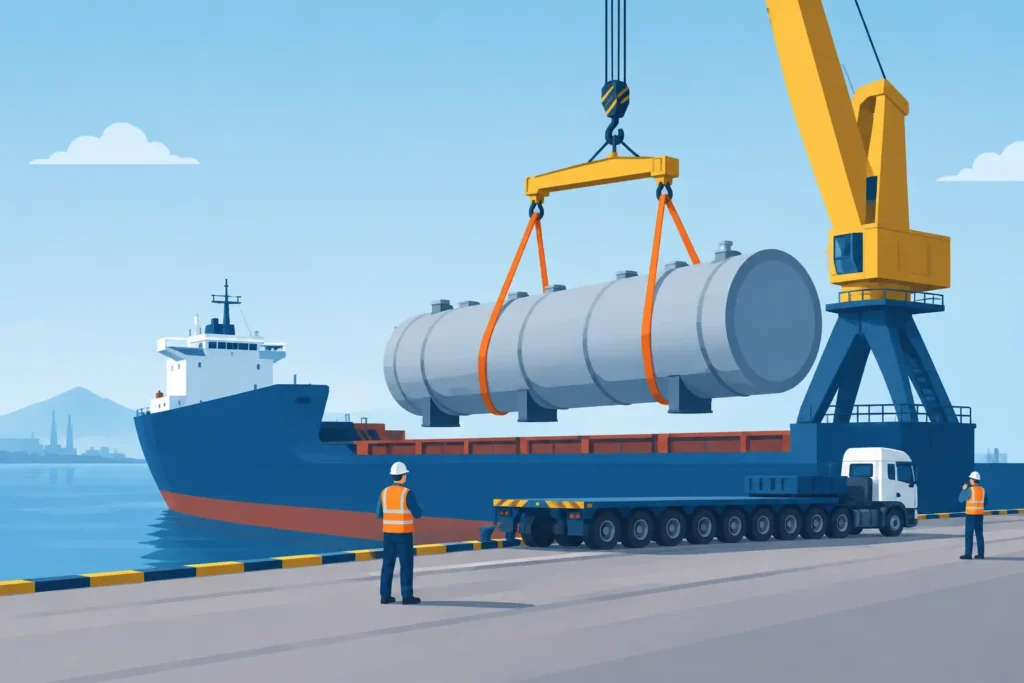
A 48-ton transformer will not become container cargo simply because a container service is available on the route. When to choose break bulk depends on the cargo’s dimensions, weight, lifting requirements, delivery site, and the cost of moving it safely from origin to final destination. For importers and exporters moving project equipment through India, the UAE, and global trade lanes, break bulk can be the most practical option when conventional container shipping creates avoidable risk or delay.
Break bulk shipping moves cargo as individual pieces rather than packed inside standard shipping containers. The shipment may travel in crates, cases, bundles, skids, or directly as a large unit. It is commonly used for machinery, industrial equipment, steel products, generators, turbines, construction components, yachts, and other cargo that is too large, too heavy, or poorly suited to containerization.
When to Choose Break Bulk Over Container Shipping
Break bulk is usually the right choice when the cargo cannot fit safely inside a standard 20-foot or 40-foot container. Dimensions are only part of the decision. A cargo unit may fit physically but still exceed container payload limits, require lifting points that cannot be handled at a container terminal, or need special stowage that makes a container impractical.
Heavy machinery is a common example. A large press, boiler, excavator component, or power-generation unit may need to be lifted by mobile crane and secured directly in a vessel hold or on deck. Forcing such cargo into a container can add packing costs, increase handling, and create a greater chance of damage during loading and unloading.
Break bulk can also make sense for cargo with unusual shapes. Long pipes, fabricated steel sections, wind-energy components, and oversized machinery often create excessive overhang or cannot be properly braced in a container. Flat racks and open-top containers may work for some out-of-gauge shipments, but they are not automatically the best alternative. Availability, port acceptance, lashing requirements, and ocean freight rates should all be compared before choosing a method.
Cargo Profiles That Benefit From Break Bulk
The strongest case for break bulk involves a cargo profile that needs specialized lifting, securing, or vessel handling. Project cargo frequently falls into this category because shipments are made up of large individual pieces that must arrive in sequence for installation.
Break bulk is particularly suitable for:
- Heavy industrial machinery, including generators, turbines, compressors, and transformers
- Large steel structures, pipes, coils, beams, and fabricated components
- Construction and mining equipment that cannot be containerized economically
- Energy, infrastructure, and marine project cargo with specialized lifting needs
- Large vehicles, boats, or equipment that require an alternative to RORO or container shipping
These shipments are not defined by size alone. A relatively compact machine with concentrated weight may require break bulk handling, while a larger but lighter item may move safely on a flat rack. The cargo’s center of gravity, lifting points, packaging strength, and susceptibility to weather are as important as its length, width, and height.
Consider the Full Handling Journey
The ocean voyage is only one part of the operation. Break bulk cargo may be handled several times: at the factory, during inland transport, at the port, on the vessel, at the destination port, and at the final delivery site. Each movement must be planned around the cargo’s actual characteristics.
For example, a machine loaded at a factory in India may require a low-bed trailer, route surveys for bridge clearances, crane coordination at the port, and marine lashing before sailing to Jebel Ali or another UAE gateway. At destination, customs release, port handling windows, permits, and last-mile delivery equipment must be ready before the vessel arrives. A gap in any part of this sequence can create storage costs and operational delays.
Cost Is About More Than the Ocean Freight Rate
Break bulk is not always cheaper than container shipping. Individual cargo handling, crane use, terminal charges, cargo lashing, and special inland equipment can increase the total cost. However, comparing only the freight quote can lead to the wrong decision.
A container option may appear less expensive at first, yet require custom crating, dismantling, multiple containers, special packing labor, and reassembly at destination. It can also expose the cargo to more handling than a properly planned break bulk shipment. In these cases, break bulk may offer better overall value despite a higher line-item ocean freight charge.
Supply chain managers should compare landed logistics cost rather than booking price. This means accounting for origin collection, export packing, permits, port charges, vessel loading, insurance, destination clearance, delivery, and the cost of delay. For project shipments, the financial impact of a missed installation date can outweigh a modest difference in freight cost.
Timing and Vessel Availability Matter
Container shipping generally offers frequent sailings and standardized schedules. Break bulk services may operate on less frequent vessel rotations, and vessel space can be limited for high and heavy cargo. This does not make break bulk unreliable, but it does require earlier planning.
If your cargo has a firm construction, shutdown, or commissioning deadline, begin the transport review well before the equipment is ready. The freight forwarder needs time to assess vessel options, confirm port capabilities, prepare loading plans, arrange surveys, and coordinate heavy-lift equipment.
There are also situations where break bulk provides a schedule advantage. When an item is too large for container equipment and cannot wait for a suitable flat rack or specialized container allocation, direct break bulk loading may be the faster route. The answer depends on the trade lane, port infrastructure, and cargo readiness date.
Port Capability and Customs Planning Are Essential
Not every port can receive every kind of break bulk shipment. The selected origin and destination ports must have suitable berths, cranes, yard space, handling teams, and access for oversized road transport. Some cargo may require vessel gear, shore cranes, or floating cranes, each with different limits and costs.
Customs preparation is equally important for India-UAE and international shipments. Commercial invoices, packing lists, certificates, permits, tariff classification, and cargo descriptions should accurately reflect the shipment. Vague descriptions such as “machine parts” can create clearance questions, especially where the cargo is oversized, high-value, or intended for a specific project.
For temporary imports, exhibition equipment, repair-and-return movements, or project equipment that will later be re-exported, the customs structure should be addressed before shipment. Documentation and duty treatment vary by country and cargo purpose. Early review reduces the risk of cargo waiting at port while paperwork is corrected.
Protecting Break Bulk Cargo at Sea
Break bulk cargo is exposed to different risks than sealed container cargo. It may be lifted in the open, stored in port yards, or carried on deck depending on vessel and stowage requirements. Proper export packing, weather protection, lifting plans, and lashing are therefore central to shipment safety.
Cargo should be assessed for moisture sensitivity, corrosion risk, vibration, and potential movement during sea transit. Industrial equipment may need vacuum packing, shrink wrapping, tarpaulin protection, desiccants, timber cradles, or steel supports. Lashing calculations should reflect the cargo weight, center of gravity, vessel position, and expected sea conditions.
Marine cargo insurance should be reviewed before loading, not after an incident. The policy must match the cargo value, route, handling method, and declared terms of sale. For high-value equipment, documenting condition through photographs, surveys, and loading records provides added protection if a claim becomes necessary.
Questions to Ask Before Booking Break Bulk
Before selecting break bulk, confirm the cargo dimensions, gross weight, lifting points, center of gravity, and packaging condition. Then determine whether the origin and destination can accommodate the required trucks, cranes, and port handling. It is also wise to establish who is responsible for loading, lashing, customs formalities, terminal charges, and final-site unloading under the agreed shipping terms.
A capable freight partner should provide a transport plan rather than only a rate. That plan should explain the proposed vessel type, handling sequence, port requirements, documentation needs, estimated transit timing, and potential operational constraints. At Mass Freight Forwarding, this coordinated approach helps shippers move specialized cargo with greater control across India, the UAE, and international markets.
The best time to choose break bulk is before cargo reaches the port, when there is still time to engineer the movement around the shipment rather than trying to make the shipment fit a standard service. Share accurate cargo drawings, photographs, weights, and delivery requirements early, and the transport plan can be built for safe execution from the first lift to final delivery.