
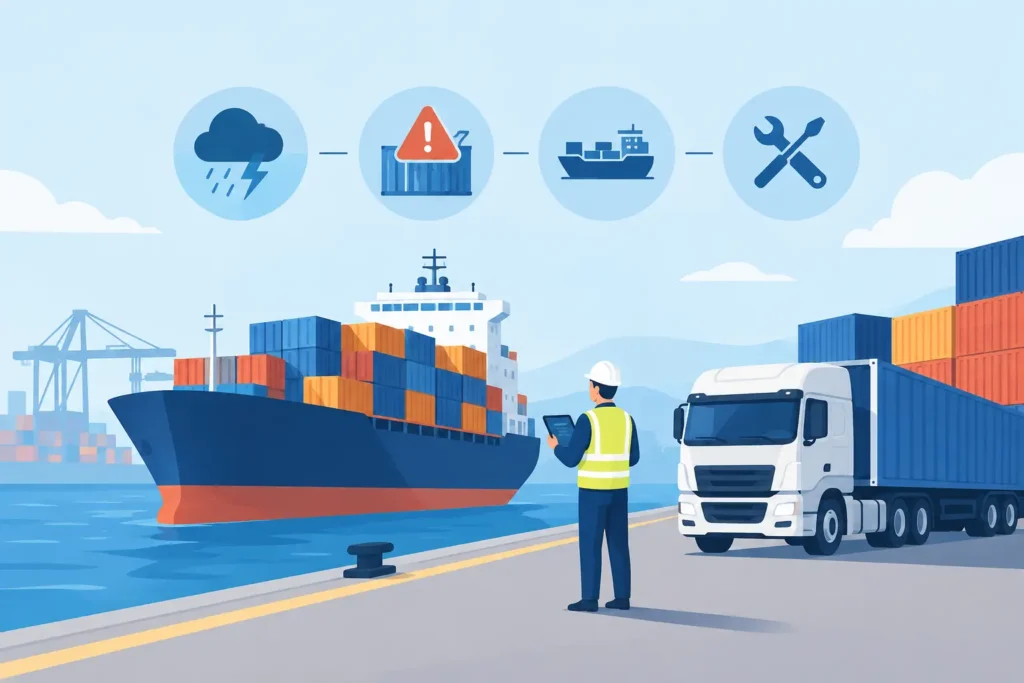
A container can arrive at Jebel Ali on schedule and still miss its planned delivery date. An air shipment can land in Mumbai overnight but wait days for release. Why do shipments face delays when the vessel or aircraft has already completed its journey? Because international freight is not one event. It is a chain of bookings, documents, inspections, handling points, clearance steps, and final-mile arrangements. A delay at any point can affect the next.
For importers, exporters, and supply chain managers trading through India, the UAE, and global markets, the goal is not to expect every shipment to move without disruption. It is to understand where delays begin, identify which risks can be controlled, and build a shipping plan that protects inventory, customer commitments, and cost.
Why Do Shipments Face Delays in International Freight?
Most shipment delays fall into three categories: operational disruption, regulatory requirements, and planning gaps. Some are outside a shipper’s control, such as severe weather or a port closure. Others are preventable, including inaccurate paperwork, late cargo handover, or choosing a transit plan with no allowance for congestion.
The type of freight matters as well. Air freight is generally faster but can be affected by airline capacity, security screening, and connection schedules. Ocean freight carries larger volumes at a lower unit cost, but sailing schedules, port congestion, and transshipment connections introduce more variables. Land transport depends on border procedures, driver availability, road conditions, and appointment times at warehouses or ports.
A dependable freight plan considers the full door-to-door route, not only the published transit time from port to port or airport to airport.
Port Congestion and Terminal Delays
Port congestion is one of the most visible causes of ocean freight delay. When terminals receive more vessels, containers, or trucks than they can process at normal speed, ships may wait at anchorage and containers may take longer to discharge, inspect, or release.
Congestion can occur during peak retail seasons, after weather events, during labor shortages, or when vessel schedules bunch together following an earlier disruption. A delay at one major port can also create missed connections at transshipment hubs, affecting cargo moving between Asia, the Middle East, Europe, and North America.
For cargo moving through the UAE or India, terminal procedures and gate appointment availability can also affect how quickly containers leave the port. Even after customs release, the shipment may need to wait for delivery order processing, equipment availability, or a truck slot.
Customs Holds and Documentation Errors
Customs clearance protects national security, revenue collection, and trade compliance. It also requires precise information. A mismatch between the commercial invoice, packing list, bill of lading, certificate of origin, product description, or declared value can lead to a query, document request, examination, or hold.
Common issues include vague cargo descriptions such as “parts” or “samples,” incorrect HS classification, inconsistent shipper or consignee details, missing licenses, and undervalued declarations. Restricted or regulated goods may require additional approvals before release. These can include food products, cosmetics, batteries, medical devices, chemicals, telecommunications equipment, automotive cargo, and items subject to standards or safety controls.
In India and the UAE, clearance requirements can vary by commodity, shipment value, import purpose, and port of entry. The fastest way to avoid preventable holds is to prepare the document set before the cargo departs, rather than waiting until it arrives.
Weather, Route Changes, and Carrier Disruptions
No freight forwarder or carrier can control a cyclone, dense fog, flooding, sandstorm, or storm-related port closure. Weather can stop vessel operations, limit aircraft movements, close roads, and prevent safe cargo handling. The effect often continues after the weather clears because terminals and carriers must work through accumulated backlogs.
Carriers may also omit a port call, change the vessel rotation, cancel a sailing, or reroute cargo due to operational constraints. In air freight, a flight cancellation or missed connection can move cargo to the next available uplift. This is why published transit time should be treated as a planning reference, not an unconditional delivery guarantee.
The right response depends on the cargo. A replenishment shipment may tolerate a revised ocean schedule. High-value, urgent, or production-critical goods may justify air freight, a different gateway, or a split shipment. The faster option costs more, so the decision should be based on the financial impact of a stockout or missed production date.
The Planning Gaps That Create Avoidable Delays
Not every late shipment is caused by a dramatic external event. Many delays begin before cargo reaches the origin port or airport.
Late booking is a frequent problem during high-demand periods. If space is limited, a carrier may offer a later sailing or flight, or cargo may be rolled to the next departure. Late cargo handover has the same result: freight that misses a terminal cutoff cannot board the intended vessel or aircraft.
Packaging and cargo readiness also matter. Improperly packed goods may fail warehouse acceptance, require repacking, or be rejected for safety reasons. Dangerous goods, oversized cargo, vehicles, and project equipment require added planning because they may need specialized documentation, packing, lashing, permits, inspections, or equipment.
Poor communication between suppliers, buyers, warehouses, brokers, and transport providers can create another hidden delay. If the supplier changes the number of packages, cargo dimensions, readiness date, or commodity details without notice, the booked equipment and documents may no longer match the shipment.
Delivery Delays After Customs Release
Customs release is a major milestone, but it is not the same as final delivery. Containers can still face delays due to unpaid destination charges, missing original documents where applicable, delivery-order processing, chassis or truck shortages, warehouse appointment limits, or consignee receiving restrictions.
Demurrage and detention risk increases when a container remains at the terminal or with the consignee beyond the free-time allowance. These charges can escalate quickly and turn a manageable operational issue into an expensive one. Importers should confirm delivery arrangements, unloading capacity, and return plans before the container is released.
For LCL groupage cargo, deconsolidation adds another handling stage. The container must be unloaded at a freight station, cargo sorted, documentation completed, and individual consignments made ready for collection or delivery. This is efficient for smaller shipments, but it can take longer than a full-container movement.
How to Reduce Shipment Delays
Delay prevention starts with realistic planning. Build lead time around the entire route: supplier production, pickup, export clearance, terminal cutoff, transit, transshipment, import clearance, and delivery. Do not base a customer promise solely on the carrier’s sailing or flight duration.
Before dispatch, confirm the commodity classification, required permits, invoice value, origin details, package count, weights, and dimensions. Give customs brokers and freight partners complete information early, especially for regulated goods or first-time imports. If cargo is sensitive, urgent, oversized, or high-value, state that at the quotation stage so the transport plan can reflect the real requirements.
It also helps to maintain a practical contingency plan. For recurring trade lanes, identify alternative ports, airports, carriers, and transport modes. Keep safety stock for goods where a late arrival would stop production or sales. Use milestone updates to act early when a vessel is delayed, a document is queried, or a delivery appointment is at risk.
A capable freight partner does more than book transport. They coordinate origin handling, carrier schedules, customs preparation, destination release, and final delivery while giving the shipper a clear view of exceptions. Mass Freight Forwarding supports this end-to-end coordination across India, the UAE, and international trade lanes, including standard freight, customs handling, vehicles, and specialized cargo.
When a Delay Happens, Act Before Costs Increase
Once a delay is confirmed, ask for the specific reason, the revised milestone, and the action needed from each party. “Delayed at port” is not enough. Determine whether the cargo is waiting for a customs document, a terminal release, a carrier connection, an inspection, payment, or delivery capacity.
Then assess the commercial impact. Can the consignee accept a partial delivery? Can critical cartons move by air while the balance continues by sea? Is it better to collect LCL cargo directly from the freight station? These decisions are most effective when made early, before storage, demurrage, missed production, or customer penalties build up.
Freight delays cannot be eliminated completely, but uncertainty can be managed. Clear documentation, realistic lead times, early booking, and active coordination give your cargo the best chance of arriving fast, secure, and cost-effectively – even when the route does not go exactly as planned.