
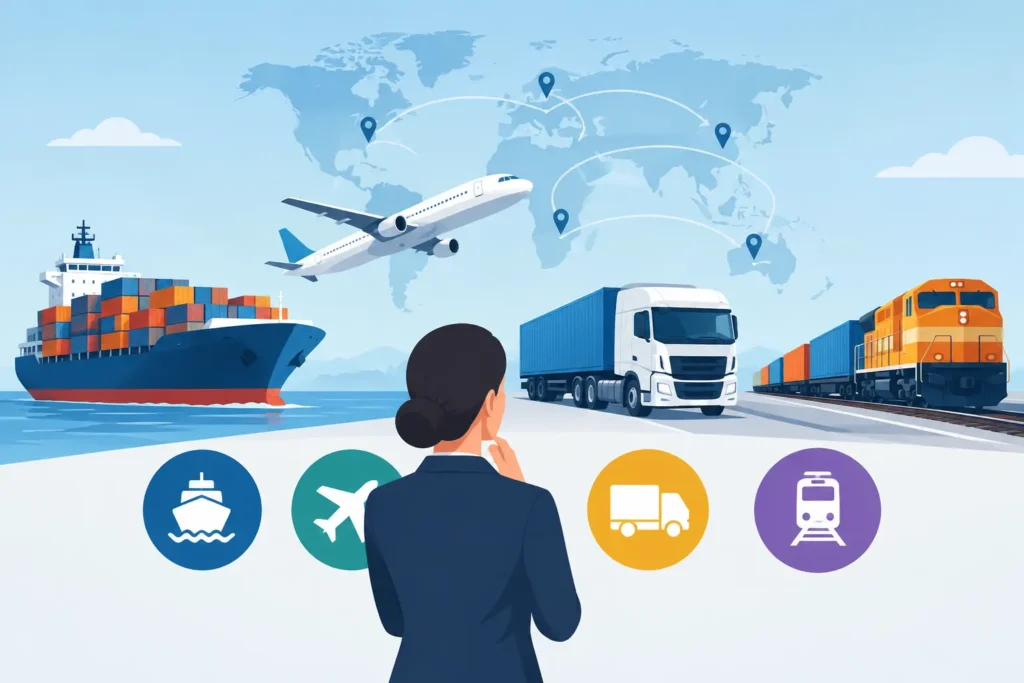
A shipment leaving Mumbai for Dubai, Chennai for Europe, or Jebel Ali for the United States can fail to meet its commercial goal even when the product is excellent. The difference often comes down to transport selection. Understanding the top freight modes for exporters helps businesses protect margins, meet buyer delivery dates, and move cargo with the right level of control.
There is no single best mode for every shipment. A time-sensitive electronics consignment calls for a different plan than a full container of industrial machinery, a partial load of consumer goods, or a luxury vehicle. The right decision considers transit time, landed cost, cargo dimensions, destination access, customs requirements, and the consequences of delay.
Top freight modes for exporters and where they fit
For most international trade, exporters rely on air, ocean, road, rail, or a combination of these modes. Each has a clear operational role. Choosing well starts with an honest assessment of what the shipment needs rather than selecting the cheapest rate or fastest transit time in isolation.
Air freight for urgent, high-value cargo
Air freight is the practical choice when delivery speed has a direct business value. It is commonly used for spare parts needed to prevent a production shutdown, medical supplies, product samples, electronics, fashion goods, and high-value commercial cargo. Major airports in the UAE and India also provide useful connections to global markets, making air freight particularly effective for time-critical trade lanes.
The main benefit is speed. Airport-to-airport transit can take a matter of days rather than weeks, although pickup, export customs clearance, screening, airline handling, import clearance, and final delivery must all be included in the actual schedule. Exporters should avoid promising an air transit time to a buyer without allowing for these ground operations.
The trade-off is cost. Airfreight charges are based on actual weight or volumetric weight, whichever is higher. Light but bulky cartons can therefore cost more than expected. Air cargo also has tighter limits for dangerous goods, oversized pieces, and certain battery-powered products. When the cargo is compact, valuable, and urgent, the premium is often justified. When it is heavy, low-margin, or easily planned weeks ahead, ocean freight usually offers better economics.
Ocean freight for volume and cost control
Ocean freight remains the foundation of global merchandise trade because it handles large volumes at a lower cost per unit than air transport. It is well suited to furniture, textiles, equipment, consumer products, raw materials, packaged goods, and non-urgent machinery. For exporters moving regular cargo between India, the UAE, and overseas markets, ocean freight can provide the predictability needed for long-term procurement and sales planning.
Full container load, or FCL, is generally the best fit when cargo can fill most of a 20-foot, 40-foot, or high-cube container. It offers better cargo separation, fewer handling points, and clearer control over loading and sealing. It can also be economical before the container is completely full, depending on the route and freight rates.
Less-than-container load, or LCL groupage, allows exporters to share container space with other shippers. This is useful for smaller orders, market-entry shipments, and companies that do not yet have enough volume for FCL. LCL reduces the need to wait until a full container is available, but it involves consolidation and deconsolidation at container freight stations. That means more handling, additional lead time, and a greater need for strong packing and accurate documentation.
Ocean shipping requires planning. Port congestion, vessel schedule changes, weather, transshipment connections, and destination clearance can affect arrival dates. Exporters should build realistic buffers into buyer commitments, especially during peak shipping seasons. A lower ocean rate is only valuable if the cargo reaches the customer in time to support the sale.
Road freight for regional distribution and cross-border trade
Road freight is essential for domestic collection and delivery, port and airport transfers, and regional cross-border movements. It is particularly relevant for trade within the GCC, where trucking can provide direct door-to-door movement between the UAE and neighboring markets. In India, road transport connects manufacturing centers, inland container depots, airports, and seaports across a vast and varied network.
For regional shipments, road freight can offer a strong balance of speed and flexibility. Trucks can collect cargo from a factory, deliver to a consignee, and accommodate changing pickup schedules more easily than fixed vessel or airline departures. It is suitable for palletized goods, retail stock, machinery, construction materials, and temperature-controlled cargo when the correct equipment is arranged.
The limitations are distance, border procedures, driver-hour rules, road conditions, and permit requirements for oversized loads. Cross-border trucking also depends on correct customs documentation at both ends. A shipment may be physically close to its destination but still face delay if invoices, packing lists, certificates, or customs declarations do not match the cargo.
Rail freight for selected corridors and steady volumes
Rail freight can be a valuable option where reliable rail corridors connect the origin and destination. It is often used for bulk commodities, containerized cargo, heavy industrial materials, and regular high-volume movements. Rail can offer a lower-carbon alternative to long-distance trucking and may provide more stable transit performance than road on certain domestic or regional lanes.
For many exporters, rail is not a standalone answer. It usually forms one part of a multimodal plan, with trucks moving cargo to and from rail terminals. Its viability depends heavily on terminal access, equipment availability, schedule frequency, and the destination network. If cargo requires multiple transfers or rail terminals are far from the shipper and buyer, the savings may disappear.
Multimodal freight when one mode is not enough
The most effective export plan often uses more than one mode. A shipment may move by truck from a factory to a port, by ocean to Jebel Ali, and by road to the final GCC destination. Urgent components may travel by air while the main order moves by sea. Rail may support a long inland leg before cargo is loaded into a container for export.
Multimodal planning is not simply about combining transport types. It requires coordination of handovers, cargo security, documentation, customs clearance, insurance, and shipment visibility. Every handover introduces a potential delay or damage point, so responsibilities should be clear from pickup through final delivery.
How to choose the right freight mode
Start with the delivery promise made to the buyer. Work backward from the required delivery date, allowing time for production completion, cargo readiness, export clearance, transit, import clearance, and final-mile delivery. This approach is more reliable than choosing a mode based only on the published transit time.
Next, calculate the total landed logistics cost. Compare freight charges alongside origin handling, destination charges, trucking, customs brokerage, storage risk, insurance, packaging, and any cost of delayed inventory. A lower headline rate can become expensive when it creates demurrage, detention, missed sales, or emergency air shipments later.
Cargo characteristics matter just as much. Measure and weigh every package accurately. Identify whether the goods are hazardous, temperature-sensitive, fragile, oversized, high-value, or subject to export controls. A container may be ideal for standard cargo, while break bulk or project logistics may be necessary for out-of-gauge machinery. Vehicles may require RORO shipping, containerization, or specialist lashing depending on their value, condition, and destination requirements.
Finally, assess route reliability and customs complexity. A direct service with a modestly higher cost can be preferable to a low-cost route involving several transshipments. Exporters trading through India and the UAE should also ensure their freight partner can manage documentation and customs procedures on both sides of the movement. Freight transport and customs compliance are connected operational decisions, not separate tasks.
Packing, insurance, and visibility protect the shipment
The transport mode determines the stresses cargo will face. Ocean shipments need moisture protection, container securing, and packaging that can withstand longer handling cycles. Air cargo needs compact, compliant packaging that meets airline and security requirements. Road movements need load restraint appropriate for turns, vibration, and variable road conditions.
Marine cargo insurance deserves attention for every shipment with meaningful commercial value. Carrier liability can be limited and may not equal the invoice value of the goods. Proper coverage should reflect the cargo, route, handling points, and agreed sales terms.
Exporters also benefit from defined shipment milestones: pickup, customs clearance, terminal receipt, departure, arrival, destination clearance, and delivery. Visibility is not only about receiving updates. It gives procurement and sales teams time to respond when a schedule changes.
Mass Freight Forwarding helps exporters match air, ocean, land, and specialized freight services to the actual demands of their cargo and trade lane. The most reliable choice is the one that supports your customer commitment, protects the goods, and keeps total logistics cost under control. Before confirming the next export order, review the cargo and delivery requirement with the same care used to price the product.